Type “BBL deaths” into Google and you’ll get a wall of articles built around the same statistic: a 1-in-3,000 mortality rate. That number is real. It came out of a South Florida mortality review in 2017 that genuinely shook the field and pushed the American Society of Cosmetic Surgeons into an emergency warning. It’s also the single most-cited fact about the procedure, and it’s almost a decade old.
The conversation about BBL safety in 2026 doesn’t look much like the one Google still surfaces. Patients walk into consultations with the 2017 number in their head and they deserve an honest answer about what changed since then. Here it is, including the parts that aren’t flattering.
The 2017 warning was driven by a multi-year mortality review concentrated in South Florida. Researchers documented a fatality rate near 1-in-3,000, and the cause was usually the same: fat injected too deep, into or below the gluteal muscle, where it could enter blood vessels and travel to the lungs as a pulmonary fat embolism.
That warning changed two things. It changed how the procedure is taught. And it tightened, eventually, who actually performs it well, because a meaningful share of the BBLs being done in 2017 were not being done by board-certified surgeons in accredited surgical facilities.
Two surgical boards in the United States carry the rigor required for BBL: the American Board of Plastic Surgery (ABPS) and the American Board of Cosmetic Surgery (ABCS). They credential through different paths but with comparable rigor.
ABPS-certified surgeons complete a plastic surgery residency. ABCS-certified surgeons complete a residency in a related surgical field (general surgery, OB-GYN, head-and-neck, dermatology, or plastic surgery itself), then complete a one-year accredited cosmetic surgery fellowship dedicated to high-volume aesthetic training. Both boards require written and oral examinations, accredited facility privileges, and ongoing maintenance of certification.
For BBL specifically, what matters is that the surgeon holds certification from one of these two boards and uses current technique in an accredited operating room. A surgeon “board-certified” in something unrelated, or in no board at all, is not in the same category and the safety data reflects that.
Two technical shifts did most of the work. The first was a strict move to subcutaneous-only fat grafting: the fat goes above the muscle, never into it or below it. The second was the routine use of intraoperative ultrasound, which lets a surgeon see the cannula tip in real time relative to the muscle fascia.
Subcutaneous-only injection alone reduced fatal embolism dramatically. Ultrasound closed most of what remained, because once you can see exactly where the cannula is, drifting into deep tissue stops being an accident waiting to happen.
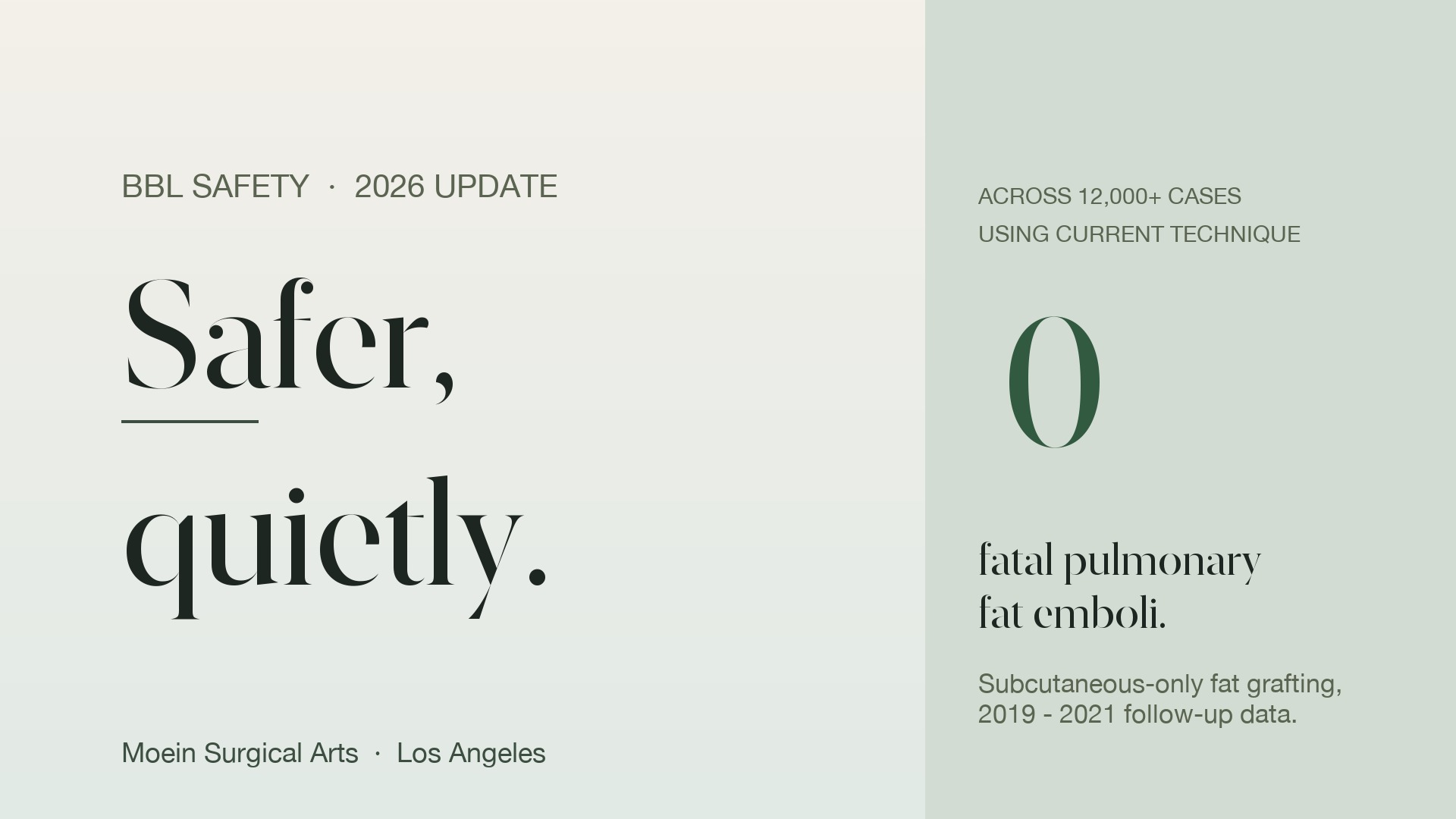
Follow-up surveys of board-certified surgeons using the post-warning technique tell a story that hasn’t really hit the public conversation. Across more than 12,000 documented cases between 2019 and 2021 using subcutaneous-only fat grafting, zero fatal pulmonary fat emboli were reported. Centers running ultrasound-guided BBL programs have published similar zero-fatality outcomes, with safety profiles that line up with other major body procedures.
That doesn’t make BBL risk-free. Every surgery has risk. But the distance between “deadliest cosmetic surgery” and “comparable to other major cosmetic surgeries” is the real story of the last five years. Most patients I see have never heard it.
Because the risk hasn’t disappeared. It moved.
The deaths still happening in 2026 cluster in two places: medical tourism destinations with weak regulatory oversight, and practitioners without ABPS or ABCS certification performing the procedure outside accredited facilities. A patient flying to a discount BBL clinic abroad is taking on a different risk than a patient walking into an AAAHC-accredited operating room in Los Angeles.
The public health data tracks this. Mortality patterns follow the regulatory environment more closely than they follow the procedure name. The same operation, in the same year, performed two different ways, has two different safety profiles.
Some version of “would you let your wife or your sister have this done?” comes up in almost every BBL consultation now. People ask it because they’ve read the Newsweek piece where surgeons were quoted anonymously saying they wouldn’t personally get one.
The answer in 2026, with a board-certified surgeon (ABPS or ABCS), ultrasound-guided subcutaneous-only technique, and an accredited facility, is yes. The answer changes the moment any one of those three is missing.
This part has nothing to do with mortality, but it matters. The hyper-projected, maximum-volume BBL of 2018 to 2022 is no longer what most patients are asking for. A real and growing group of women is now coming in for reversal or reduction on results that felt right four years ago and feel exaggerated now.
That changes how I plan a primary BBL today. Patients are asking for natural proportions and an outcome that ages well. The conservative conversation is back on the table in a way it wasn’t in 2019, and that’s a good thing for both safety and longevity of result.
If you’re researching the procedure, here are the six questions whose answers actually tell you something:
1. Are you board-certified by the American Board of Plastic Surgery (ABPS) or the American Board of Cosmetic Surgery (ABCS)? Either is acceptable. Both require accredited training, examinations, and ongoing maintenance. What you want to avoid is “board-certified” with no board named, or certification in an unrelated specialty being implied as cosmetic-surgery credentialing.
2. Is the surgical facility AAAHC, AAAHC, or state-licensed? An accredited operating room is a hard line, not a preference.
3. Do you use intraoperative ultrasound during fat grafting? If the answer is no, find another surgeon. This is the standard of care now.
4. Is your fat grafting strictly subcutaneous? The answer you want is some version of “yes, exclusively above the muscle.”
5. What is your annual BBL volume and your complication rate? A surgeon who knows these numbers and tells you them is a surgeon who tracks them seriously.
6. What does revision look like in your practice? Even with perfect technique, results evolve. The plan for that matters.
If a surgeon hesitates on any of these, take that as information.
Not for board-certified surgeons (ABPS or ABCS) using current subcutaneous-only technique with intraoperative ultrasound. The historical figure was driven by cases that included deep intramuscular injections, often performed outside accredited facilities and outside legitimate board credentialing. The current safety profile in compliant US practices is dramatically better.
Not for the patient’s safety calculus, no. Both boards require completed surgical residency, specialty training, written and oral examinations, accredited facility privileges, and maintenance of certification. The training paths are different but the rigor is comparable. What matters far more than which of the two boards is which technique the surgeon uses, what facility they operate in, and how many BBLs they perform per year.
Across more than 12,000 documented cases between 2019 and 2021 using current technique, zero fatal pulmonary fat emboli were reported. The risk hasn’t gone to zero (no surgery does), but fatal complications in compliant US practices are now rare events rather than ones the field expects to see annually.
Yes. Mortality data tracks closely with regulatory environment. Cost-driven travel to facilities with weaker oversight, less surgical accreditation, and surgeons who may not hold ABPS or ABCS certification is where most of the remaining BBL risk concentrates.
That Newsweek piece was published before the technique evolution had fully spread through the field. Many of those surgeons would give a different answer in 2026 if asked specifically about ultrasound-guided subcutaneous-only BBL by a board-certified colleague using current standards.
It’s real and it’s growing, but it’s primarily aesthetic, not safety-related. Patients who got large-volume results in 2018 to 2022 are finding the outcome no longer matches the look they want or the way their body has changed. Reduction and revision options are part of what most LA practices now offer.
BBL costs in Los Angeles run in a similar range to other major body procedures, with the variables being surgical volume, anesthesia time, and combination cases. The butt lift cost breakdown walks through what drives the number.
BBL went through a hard public reckoning between 2017 and 2021. The technique evolved, the credentialing tightened (across both ABPS and ABCS), and the data on compliant US practices shifted substantially. That story hasn’t fully reached the public conversation, where the 2017 figure still leads every search result.
If you’re considering a BBL today and trying to figure out whether it’s safe enough for you, the answer depends almost entirely on who is doing it and where. Same surgery, two ways of performing it, two different risk profiles. A patient making this decision deserves to know which one they’re actually choosing.
If you’d like to ask any of these questions in person, I do virtual consultations from Los Angeles. The pre-surgical conversation is where the safety of any procedure is really established.
Dr. Babak Moein is a board-certified surgeon in Los Angeles, certified by the American Board of General Surgery and a Diplomate of the American Board of Cosmetic Surgery. His practice focuses on body contouring, mommy makeover, and breast procedures. More on Dr. Moein’s training and approach.