Ab etching and a tummy tuck both promise a better-looking midsection, so patients often assume they are two versions of the same thing and ask which is cheaper or faster. They are not versions of the same thing. They solve different problems. Choosing the wrong one is the most common way people end up disappointed with an otherwise well-done surgery, because the operation was excellent but it was never going to fix what actually bothered them.
This guide explains what each procedure does, who each one is for, and how to know which fits your body. If you already know you want muscle definition rather than skin removal, our page on ab etching goes deeper on that specific procedure.
Ab etching sculpts fat to reveal muscle definition on a firm abdomen. A tummy tuck removes loose skin and repairs stretched or separated muscle. One is about revealing what is underneath. The other is about rebuilding the foundation. If your problem is a stubborn fat layer over good muscle, etching is your procedure. If your problem is hanging skin or a stomach that bulges no matter how much you train, a tummy tuck is.
Ab etching is high-definition liposuction focused on the abdomen. It works best when the skin is firm and the muscle is developed, and there is simply a layer of fat blurring the definition. It does not tighten loose skin and it does not repair separated muscles. Ask it to do those jobs and it will fail, not because it was done poorly, but because it was the wrong tool.
A tummy tuck, or abdominoplasty, removes excess skin, tightens the abdominal wall, and repairs diastasis recti, the separation of the abdominal muscles that commonly follows pregnancy or major weight change. It leaves a low scar in exchange for a flat, firm abdomen that diet and exercise cannot achieve on their own. For patients who do not need a full tuck, a mini tummy tuck addresses looseness limited to below the navel.
Here is the test that settles most cases. If your abdomen bulges outward even when you are lean, or you can feel a gap down the center of your stomach when you tense, you likely have separated muscles. No amount of fat sculpting will flatten that, because the bulge is the abdominal wall itself, not fat. Similarly, if you have loose skin that folds or hangs, etching will remove fat from underneath and can actually make loose skin look worse. Both of those problems are tummy-tuck problems.
| Ab etching | Tummy tuck | |
|---|---|---|
| Main goal | Reveal muscle definition | Remove loose skin, repair muscle |
| Best candidate | Firm skin, developed muscle, stubborn fat | Loose skin or separated muscle (diastasis) |
| Addresses loose skin? | No | Yes |
| Repairs muscle separation? | No | Yes |
| Scar | Tiny incision sites | Low horizontal scar |
| Recovery to desk work | About a week | Roughly two weeks |
Patients who have lost a large amount of weight, whether through surgery or GLP-1 medication, almost always have loose skin as the primary issue. For them, skin removal comes first. Etching for definition, if desired, is a later step once the foundation is set. Our overview of post-weight-loss body contouring explains how skin removal and contouring are sequenced after significant weight loss.
Yes, and for the right patient it is the ideal answer. A tummy tuck rebuilds the flat, firm foundation, and etching then adds definition to that foundation. This is common for post-pregnancy and post-weight-loss patients who want more than a flat stomach. The two can sometimes be staged and sometimes combined, depending on your anatomy and how much work each area needs. The plan should be built around your body, not around a package.
Ab etching sculpts fat to reveal muscle definition on a firm abdomen. A tummy tuck removes loose skin and repairs separated abdominal muscles. Etching reveals; a tummy tuck rebuilds the foundation.
No. Ab etching removes fat but does not tighten loose skin or repair a bulge caused by separated muscles. Those are addressed by a tummy tuck. Etching on loose skin can even make the looseness more noticeable.
If your abdomen bulges outward even when you are lean, or you feel a gap down the center of your stomach when you tense your core, you may have muscle separation. It is confirmed at an in-person exam and is repaired with a tummy tuck, not with etching.
Often yes. A tummy tuck creates a flat, firm foundation, and etching can then add definition. The two may be combined or staged depending on your anatomy and the amount of work needed.
A tummy tuck has the longer recovery, with most patients returning to desk work in about two weeks, versus about one week for ab etching. Both reach their final result over several months.
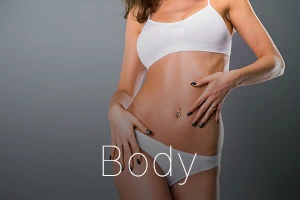
* Illustrative images on this page are models, not actual patients. Real patient results are shown in our Before & After gallery.