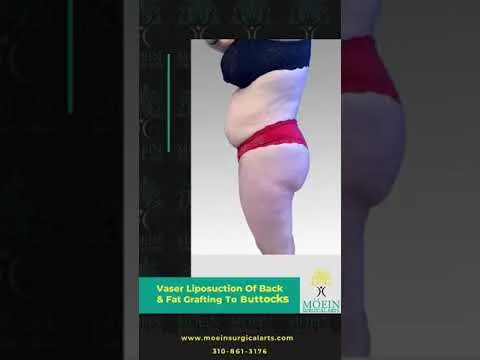
The skinny BBL answers a question I hear constantly in consultation: “I’m thin — do I even have enough fat for a Brazilian butt lift?” Usually, yes. A skinny BBL is a Brazilian butt lift adapted for lean patients, typically with a BMI under 25, where fat is harvested strategically from multiple areas and placed for shape and proportion rather than dramatic volume. The result is a subtle, athletic enhancement — a lifted, rounder contour that looks like genetics, not surgery. This page covers who qualifies, how the technique differs from a standard BBL, realistic 2026 Los Angeles pricing, and the honest limitations lean patients need to hear before booking anything.
| Skinny BBL at a Glance | Details |
|---|---|
| Best for | Lean patients (BMI typically under 25) wanting subtle, natural enhancement |
| Fat harvested from | Multiple lean-patient zones: flanks, lower back, inner thighs, abdomen, arms |
| Typical transfer volume | 300–600 cc per side (vs 600–1,200+ cc in standard BBL) |
| Technique | VASER harvest for fat viability + strategic placement for shape over size |
| Procedure time | 2.5–4 hours |
| Recovery to desk work | 7–10 days (with BBL sitting protocol) |
| 2026 Los Angeles cost | starting at $18,000 all-inclusive |
A standard Brazilian butt lift assumes generous donor fat — the surgeon liposuctions the waist and transfers large volumes to the buttocks. Lean patients break that assumption. They have less fat to give, and their aesthetic goal is usually different too: not maximum projection, but better proportion — a lifted shape, a rounder lateral curve, a waist-to-hip transition that clothing manufacturers seem to assume everyone has.
The skinny BBL adapts on both ends of the procedure. On the harvest side, fat is collected carefully from multiple smaller deposits — flanks, lower back, inner thighs, lower abdomen, sometimes the arms — because no single area on a lean body yields enough. On the placement side, every cc counts: fat is layered precisely where it creates shape (the upper pole for lift, the lateral hip for the hourglass transition) rather than distributed for bulk volume.
There’s a bonus effect lean patients often underestimate: because the donor fat comes from the exact areas that blur the waistline, the harvest itself sharpens your contour. The transformation is the combination — a tighter waist and a fuller shape — even though the transferred volume is modest.
In my experience, most patients who ask this question do qualify. What I assess at consultation:
For genuinely very lean patients (BMI under 19–20) with almost no harvestable fat, the honest alternatives are staged weight-neutral fat banking (rarely practical), butt implants, or Sculptra butt lift — an injectable collagen-stimulator approach that adds modest volume without any donor fat. We offer both pathways, so my recommendation follows your anatomy rather than what’s on the menu.
Expect roughly 60 to 70 percent of transferred fat to survive permanently — an expectation I build into the placement plan. The fat that establishes blood supply by month 3 is yours for good.
All-inclusive 2026 pricing at accredited Los Angeles practices runs starting at $18,000, or $23,000 with Renuvion J-Plasma skin tightening. Skinny BBLs sit slightly above standard BBL pricing per cc transferred because the multi-zone harvest takes longer and demands more technical care. The variables:
Get an itemized all-inclusive quote and confirm the facility’s accreditation. Financing options are covered on our financing page.
I need roughly 600 to 1,200 cc of processed, viable fat in total — meaning 300 to 600 cc placed per side. Most patients with a BMI between 20 and 25 carry that much across their flanks, lower back, inner thighs, and abdomen combined, even when no single area looks “fatty.” The multi-zone harvest is exactly what makes the skinny BBL possible for patients who were told elsewhere they were too thin.
More natural than almost any other buttock procedure — that’s essentially the point. Because volumes are modest and placement prioritizes shape over size, the result reads as a genetically fortunate figure rather than an obvious procedure. The lifted upper pole and smoother hip transition show most in fitted clothing and athletic wear. Patients seeking a dramatic, high-projection look are better served by a staged approach or implants, and I’ll tell you that honestly at consultation.
Expect 60 to 70 percent long-term survival with proper technique and aftercare. The critical window is the first three months, when transferred fat cells establish their new blood supply. VASER harvesting improves survival by keeping fat cells intact during extraction, and the two-week no-sitting protocol protects them during the most fragile phase. I over-place slightly to account for expected resorption, so the month-3 result lands where we planned.
The safety profile is driven by technique, not by patient size. The single most important standard — subcutaneous-only fat placement, never intramuscular — applies identically to both. That standard, now endorsed across the specialty, is what dramatically improved BBL safety over the past several years. Choose a surgeon board-certified by ABCS or ABPS who operates in an accredited facility and follows subcutaneous placement without exception; those three factors matter far more than the volume transferred.
I don’t recommend it, and I’d rather tell you why than quietly take the case. Deliberately gained fat distributes according to your genetics — much of it goes where you don’t want it and can’t be harvested. Post-surgery weight loss then shrinks your result, since transferred fat behaves like the fat from its donor site. Patients get better, more durable outcomes at their natural stable weight with a technique adapted to their build — which is precisely what the skinny BBL is.
Two honest alternatives. Sculptra butt lift uses an injectable collagen stimulator to build modest volume over a series of sessions — no surgery, no donor fat, subtler effect. Butt implants deliver definitive volume for very lean patients but involve a different risk and recovery profile. At consultation I’ll measure what’s actually harvestable and map all three options against your anatomy and goals — including the option of doing nothing, which is underrated in this field.
Low-volume fat transfer is a precision game: the margin for error is smaller when every cc matters. I perform every consultation and procedure personally, harvest with VASER specifically to protect fat viability, and follow subcutaneous-only placement as an absolute rule. Both the American Board of Cosmetic Surgery (ABCS) — my certifying board — and the American Board of Plastic Surgery (ABPS) are the recognized standards for this work; verify any surgeon you consult. Compare real outcomes in our BBL before-and-after gallery, and read about the standard technique on our Brazilian butt lift page.
Schedule a consultation: moeinsurgicalarts.com/contact-us · (310) 455-8020
Last updated 2026-07-04. Medically reviewed by Dr. Babak Moeinolmolki, MD, board-certified cosmetic surgeon (ABCS).
For patients whose waist stays wide even at low body fat, the limiting factor can be skeletal rather than soft tissue — flared lower ribs. Those cases pair a skinny BBL with rib remodeling or waist narrowing surgery, narrowing the frame while the fat transfer builds the hip curve.
This clip contains real operating-room footage. Viewer discretion advised.
National-average figures quoted in articles — including some on this site — are typically bare-bones estimates: the surgeon's fee alone. They usually exclude the operating facility, anesthesia, pre-op preparation, and aftercare, and they average in every market and every level of experience nationwide.
At Moein Surgical Arts, your quote is all-inclusive: pre-operative preparation and clearance, the accredited surgical facility, anesthesia, every post-operative follow-up visit, and our scar-management program — performed personally by a double board-certified surgeon in Los Angeles. One price, no surprise add-ons.