Common C-section scar problems
A cesarean incision usually heals into a thin line low on the abdomen. For many women, though, it does not settle down the way they expected. These are the problems we see most often:
- Raised, thick, or growing scars. A hypertrophic scar is thick and red but stays within the incision. A keloid grows past the incision edges. The lower abdomen is a common site for both, and the pubic area after a C-section is a known keloid location.
- Widened scars. Tension across the lower belly can stretch a scar into a broad, shiny band.
- Tethered or depressed scars. The scar sticks to deeper tissue, creating a groove or dent that can pull when you move or bend.
- The “shelf” or overhang. Skin and fat above a tethered scar can fold over it, creating a pouch that does not go away with diet or exercise.
- Nerve pain or numbness. Many women notice numbness above the scar. Some have burning, sharp, or zapping pain, which can come from nerves caught in scar tissue.
- Irritation. A thick or overhanging scar can rub against waistbands and underwear, stay moist, and develop rashes.
When to see a doctor first
Some changes are not just a scar problem. Get checked if you notice a firm lump in or near the scar that swells or hurts around your menstrual period, since this can be endometriosis that has implanted in the incision (scar endometrioma). Also see a doctor for redness, warmth, drainage, an opening in the scar, a bulge that grows when you cough or strain (possible hernia), or pain that keeps getting worse. These need a diagnosis before any cosmetic plan.
Conservative care to try first
Many C-section scars improve with simple steps, especially in the first year:
- Silicone gel or sheets. International scar guidelines name silicone the first-line therapy for raised linear scars. Use it daily for several months.
- Scar massage once the incision is fully healed, which can loosen mild tethering.
- Sun protection if the scar is ever exposed, to prevent darkening.
- Steroid injections for raised, itchy, or painful scars, often given as a short series several weeks apart.
- Pelvic floor or scar-focused physical therapy for pulling and tightness.
Keeping a record of what you tried, for how long, and how your symptoms responded is helpful both for planning and for any insurance request later.
C-section scar revision options
Excision and layered closure
The most direct fix is to cut out the old scar and close the wound again in layers. Deep stitches release the tethering and take tension off the skin, so the new scar can heal thinner and flatter. This is usually done as a short outpatient procedure under local or light anesthesia. For keloids, excision is combined with steroid injections or other added treatment, because keloids cut out alone often return.
Steroid injections
Injections soften and flatten raised scars and calm itching and tenderness. They are used on their own for smaller scars and after excision to lower the chance of a raised scar coming back.
Laser and skin resurfacing
Laser can improve texture, redness, and thickness. Fractional ablative resurfacing such as CO2 fractional laser or radiofrequency treatments such as Fractora are often used for surface irregularities, typically over several sessions. Laser does not fix tethering or a shelf of tissue, so it is usually a finishing step.
Combining revision with a mini or full tummy tuck
If loose skin, a shelf, or stretched muscles are part of the problem, a tummy tuck may be the better operation. A mini tummy tuck removes a strip of lower-abdominal skin that usually includes the C-section scar, and a full tummy tuck also tightens separated abdominal muscles and removes more skin. In both cases the old scar is typically taken out and replaced by a new, carefully placed incision low on the abdomen.
Ask any surgeon how often they revise C-section scars and how they handle tethering.
When is the right time?
- Wait about 12 months after delivery. Scars keep remodeling for a year or more, and many improve on their own. Some plans also look for a scar that has been present at least a year, unless it is hypertrophic or a keloid.
- Finish breastfeeding and reach a stable weight before a tummy tuck.
- Hold off if you plan more pregnancies. Another C-section will create a new scar, and pregnancy can stretch out the results of a tummy tuck. Simple injections and silicone can be used in the meantime.
- Exceptions: growing keloids, painful raised scars, and suspected endometrioma or hernia should be evaluated sooner.
Does insurance cover C-section scar revision?
It depends on why the scar needs revision. Our guide on how insurers decide scar revision coverage explains the general rules. For a cesarean scar, the main points are:
- Symptomatic surgical scars are often covered. Aetna’s cosmetic surgery policy (CPB 0031) states that revision of scars that result from surgery is medically necessary when they cause symptoms or functional impairment. A C-section scar that is painful, itchy, raised, bleeding, or repeatedly breaking down fits this description when it is documented.
- Medi-Cal managed care plans such as Health Net cover revision of scars from a covered procedure when pain, burning, or itching is not controlled by simple pain relievers or steroid injections, or when the scar repeatedly breaks down.
- California’s normal-appearance rule. Fully insured California plans and Medi-Cal must cover reconstructive surgery that creates “a normal appearance, to the extent possible” after surgery, trauma, or disease. A badly distorted C-section scar may qualify, although plans can deny when they expect only minimal improvement. Self-funded employer (ERISA) plans are not bound by this law.
- Overhang removal is usually self-pay. Removing a shelf of skin and fat for appearance is generally treated as cosmetic. The exception is a large hanging apron of skin (pannus) that causes rashes, infections, or hygiene problems despite treatment, which may meet criteria for a panniculectomy. Our page on whether panniculectomy is covered by insurance explains those rules. Muscle repair and contouring in a tummy tuck remain cosmetic.
To support a request, keep notes on your symptoms (with 0 to 10 pain and itch scores), the treatments you tried and when, and clear photos. Ask your surgeon to document the cause of the scar, its size, and how it affects daily life. For costs not covered by insurance, see our fees and financing options.
Frequently Asked Questions
How long after a C-section can I get scar revision?
Most surgeons recommend waiting about 12 months after delivery so the scar can finish maturing. Painful raised scars, growing keloids, or a suspected scar endometrioma or hernia can be evaluated sooner.
Does insurance cover C-section scar revision?
It may, when the scar causes symptoms such as pain, itching, bleeding, or repeated breakdown that is documented in your records. Aetna, for example, covers revision of surgical scars that cause symptoms or impairment. Revision only to change the look of the scar, or removing an overhang for appearance, is usually self-pay.
Can a tummy tuck remove my C-section scar?
Usually yes. A mini or full tummy tuck removes a section of lower-abdominal skin that typically includes the C-section scar and replaces it with a new, low incision. This works well when loose skin or a shelf of tissue is part of the problem.
Why does my C-section scar have a pouch or shelf over it?
The scar can stick to deeper tissue, so the skin and fat above it fold over the tethered line. Weight loss and exercise rarely fix it. Releasing the scar during revision, or removing the skin in a tummy tuck, is usually needed.
Is it normal for my C-section scar to hurt years later?
Mild numbness is common, but ongoing burning or sharp pain is not something you have to accept. It can come from nerves caught in scar tissue, a hernia, or scar endometriosis. See a doctor for an exam before planning revision.
Should I wait until I am done having children?
For a tummy tuck, yes, it is best to wait. A future pregnancy can stretch the results, and another C-section will create a new scar. Silicone and steroid injections can help a bothersome scar in the meantime.
Medical references
- Aetna Clinical Policy Bulletin 0031: Cosmetic Surgery and Procedures
- California Health and Safety Code 1367.63: Reconstructive surgery
- Health Net California: Cosmetic and Reconstructive Surgery policy
- Gold MH, et al. Updated international clinical recommendations on scar management, Part 2. Dermatol Surg. 2014
- StatPearls: Scar Revision (NCBI Bookshelf)
A C-section scar that hurts, pulls, or hangs over your waistband can be fixed, and the right plan depends on what is actually causing the problem. Dr. Moeinolmolki can examine the scar, rule out issues like hernia or endometrioma, and explain whether revision or a tummy tuck fits your goals. Review when insurance pays for scar revision, then book a scar evaluation or call (310) 455-8020.
Medically reviewed by Dr. Babak Moeinolmolki, MD, FACS, double board-certified through the American Board of Surgery and the American Board of Cosmetic Surgery, practicing in Los Angeles. Reviewed October 2026. This article is for education and is not a substitute for an in-person evaluation or a coverage decision from your health plan.
]]>What is a keloid, and how is it different from a hypertrophic scar?
A keloid is an overgrowth of scar tissue. After a cut, piercing, surgery, burn, or acne bump, the skin’s repair process does not switch off. The scar keeps growing and spreads past the edges of the original wound, often into a firm, shiny, rubbery lump that can be pink, red, purple, or darker than the surrounding skin.
A hypertrophic scar looks similar at first. It is also thick and raised, but it stays within the borders of the original wound, and it often softens and flattens on its own over one to two years. Keloids usually do not regress without treatment, and they can keep enlarging for years.
Medical coders file both under the same diagnosis code, ICD-10 L91.0 (hypertrophic scar, which includes keloid). Insurers such as Aetna and Anthem list L91.0 as a supporting diagnosis for keloid treatment. Acne keloids have their own code, L73.0.
Where keloids form and who is at risk
Keloids show up most often where skin is under tension or where small injuries are common:
- Earlobes, usually after a piercing
- Chest and breastbone, after surgery, acne, or minor injuries
- Shoulders and upper back
- Jawline and neck, sometimes after shaving bumps or acne
- The lower abdomen, along a C-section or other surgical incision
Risk is not equal across people. Keloids are much more common in skin of color: the NCBI Textbook on Scar Management reports incidence of roughly 4.5% to 16% in people of African descent, compared with under 1% in some Caucasian and Taiwanese Chinese groups. A family history of keloids raises the odds too, and anyone who has formed one keloid is more likely to form another.
Symptoms that bring people in
A keloid is not only a cosmetic concern. In one study of keloid patients (Lee et al., 2005), 86% reported itching and 46% reported pain. Common complaints include:
- Itching, tenderness, or burning
- Rubbing from a bra strap, waistband, or collar
- A lump that keeps getting larger
- Cracking, bleeding, or repeated infection
See a doctor promptly if a growth appears without any known injury, grows quickly, bleeds without a reason, or looks different from your other scars. A changing lump may need a biopsy. Our lump and bump removal page explains how we evaluate new skin growths.
Keloid treatment options, from first line to surgery
Expert guidelines such as the Japan Scar Workshop Consensus start with the least invasive options and reserve surgery plus an added therapy for resistant or large keloids.
Steroid and 5-FU injections
Injecting a corticosteroid (usually triamcinolone) directly into the keloid is the standard first step. It flattens the scar and often calms itching within a few sessions. 5-fluorouracil (5-FU) can be injected alone or mixed with the steroid. Combination therapy gives better height reduction and lower recurrence than either drug alone. Side effects can include skin thinning or lightening, so doses are adjusted carefully.
Cryotherapy
Freezing can shrink small, raised keloids, alone or with injections. Because cold can lighten pigment, it is used cautiously on darker skin.
Silicone, pressure, and steroid tape
Silicone and pressure soften raised scars and matter after any keloid surgery. Pressure earrings, worn many hours a day for months, are key after earlobe keloid removal.
Surgical excision plus adjuvant therapy
For a large keloid, one that has not responded to injections, or an earlobe keloid, surgery may be the best choice. The keloid is cut out and closed carefully in layers. What matters most is experience with keloids and a clear plan to prevent recurrence.
The key point is that excision alone recurs in 45% to 100% of cases. That is why surgery is almost always followed by an adjuvant, meaning an added treatment to keep the keloid from returning:
- Steroid injections into the healing incision, starting at surgery and repeated for months
- Pressure earrings or garments, plus silicone
- Post-excision radiation, a short course of superficial radiation started within a few days of surgery
A meta-analysis by Mankowski and colleagues (Annals of Plastic Surgery, 2017; 72 studies and 9,048 keloids) found recurrence of about 22% after excision plus radiation, compared with 37% for radiation used alone. Radiation works best when started soon after closure, which is why insurers set windows of 3 to 7 days.
When insurance covers keloid removal
Health plans generally treat a keloid as a medical problem when it causes pain, itching, bleeding, or a functional limitation and has been documented in your chart. Our guide on when insurance covers scar revision explains the general rules. Here is how they apply to keloids specifically:
- Aetna (CPB 0031 and 0389) considers keloid repair medically necessary if the keloid causes pain or a functional limitation, and covers intralesional steroid, intralesional 5-FU, or cryotherapy for qualifying keloids. Aetna CPB 0551 covers radiation as an add-on treatment when it begins within 7 days after excision.
- Anthem Blue Cross (CG-SURG-31) allows up to 3 radiation fractions, started within 3 days of excision, when the keloid meets its medical necessity or reconstructive criteria.
- Medi-Cal managed care plans may cover keloid revision when pain, burning, or itching is not controlled by simple pain relievers or steroid injections. Health Net’s California policy, for example, covers low-dose radiation within 7 days after keloid excision. It also excludes repair of stretched earlobe piercing holes, which is different from removing an earlobe keloid.
California adds another path. Fully insured California plans and Medi-Cal must cover reconstructive surgery that creates “a normal appearance, to the extent possible” for abnormal structures caused by trauma, surgery, infection, or disease. A disfiguring keloid can qualify even without a functional problem, although a plan may still deny a request if it expects only minimal improvement. Self-funded employer (ERISA) plans are not bound by this state law, so always confirm how your plan is funded.
What insurers usually exclude
Even when the keloid is covered, some treatments are not. Aetna lists many keloid and scar treatments as experimental, including botulinum toxin (Botox) injections, bleomycin, verapamil, interferon, PRP, microneedling, and silicone products billed as a separate item. Cigna’s scar policy takes a similar position. Our fees and financing page explains payment options for treatments your plan does not cover.
To build a strong request, keep a record of how the keloid started, your itch and pain scores, and the dates of every treatment you have tried, and ask for measured color photos. If your keloid started after an accident or assault, the costs may also be part of an injury claim. See our personal injury care in Los Angeles page.
Frequently Asked Questions
Can a keloid be removed permanently?
Sometimes, but no doctor can promise it. Excision alone comes back in 45% to 100% of cases. Combining surgery with steroid injections, pressure, or radiation started within a few days lowers that risk substantially, to about 22% with post-excision radiation in one large meta-analysis.
Does insurance cover keloid removal?
Often, when the keloid causes pain, itching, bleeding, or a functional problem and that is documented. Aetna covers keloid repair that causes pain or functional limitation, and Aetna and Anthem cover radiation after excision within set time windows. In California, a disfiguring keloid may also qualify under the state’s normal-appearance rule on fully insured plans and Medi-Cal.
What is the difference between a keloid and a hypertrophic scar?
A hypertrophic scar is thick and raised but stays inside the original wound and often flattens over one to two years. A keloid grows beyond the wound edges, rarely shrinks on its own, and is more likely to return after surgery.
How many steroid injections does a keloid need?
Most keloids need a series of injections spaced several weeks apart. The number depends on the size and thickness of the keloid and how it responds. Your doctor will reassess after each session and may add 5-FU if progress stalls.
Why does radiation have to start so soon after keloid surgery?
Radiation is meant to stop the scar-forming cells before they rebuild the keloid. It works best right after the incision is closed. Insurers reflect this: Aetna requires radiation to begin within 7 days and Anthem within 3 days of excision.
Can I get my ears pierced again after earlobe keloid removal?
It is usually not recommended. People who have formed one keloid are more likely to form another, and a new piercing can restart the process. Talk with your surgeon before any new piercing, tattoo, or elective procedure.
Medical references
- Aetna Clinical Policy Bulletin 0389: Hypertrophic Scars and Keloids
- Aetna Clinical Policy Bulletin 0551: Radiation Treatment for Selected Nononcologic Indications
- Anthem Blue Cross CG-SURG-31: Treatment of Keloids and Scar Revision
- Mankowski P, et al. Optimizing radiotherapy for keloids: a meta-analysis. Ann Plast Surg. 2017
- Ogawa R, et al. Japan Scar Workshop Consensus Document 2018. Burns Trauma. 2019
If a keloid is itching, hurting, or growing, you do not have to live with it. Dr. Moeinolmolki can examine the keloid, map out a treatment and recurrence-prevention plan, and help document what your insurer needs. Read our scar revision insurance guide to see how plans decide, then book a scar evaluation or call (310) 455-8020.
Medically reviewed by Dr. Babak Moeinolmolki, MD, FACS, double board-certified through the American Board of Surgery and the American Board of Cosmetic Surgery, practicing in Los Angeles. Reviewed October 2026. This article is for education and is not a substitute for an in-person evaluation or a coverage decision from your health plan.
]]>
Hooded eyes are one of the most-asked-about facial concerns in cosmetic surgery, and the conversation about how to address them has shifted significantly over the last three years. The procedure menu in 2026 is wider than it was in 2022, the non-surgical options have improved meaningfully, and the patient who is right for surgery vs the patient who is right for a non-surgical approach is now a more nuanced decision than it used to be.
This is an update to our previous discussion of hooded eyes treatment, focused specifically on what’s new for 2026 and which patients benefit from which approach.
What hooded eyes actually are
The “hood” is excess skin and sometimes fat in the upper eyelid that drapes over the lid crease and partially covers the lash line. It can be inherited (genetic upper-lid anatomy), age-related (skin laxity that develops over decades), or both. Some people are born with hooded eyes; others develop them gradually starting in their late thirties or forties.
The functional issue, when there is one, is that severe hooding can encroach on the upper visual field. The aesthetic issue is that the hood obscures the upper eyelid where eye makeup goes, makes the eye look smaller, and tends to read as tired or aged regardless of how rested the person actually is.
The 2026 procedure menu
What’s changed since 2022 is that the surgical and non-surgical options now actually compete with each other for some patient profiles, where they used to address different patient populations entirely.
Upper blepharoplasty (surgical). The traditional gold-standard. Removes excess upper eyelid skin and sometimes a small amount of fat. The incision sits in the natural lid crease and heals to a nearly invisible scar. Local anesthesia, in-office procedure, recovery to normal social appearance in about two weeks. The result is permanent in the sense that the removed skin doesn’t grow back, though aging continues normally.
Brow lift (surgical or thread). For patients whose “hooded eyes” are actually low brow position pulling down on the upper lid, lifting the brow back to its anatomical position addresses the issue without operating on the lid itself. The brow can be lifted surgically (open or endoscopic) or with non-surgical thread lifts that have improved significantly in 2026 with newer suture materials and placement techniques.
Botox brow lift. A targeted Botox pattern can elevate the brow position by 1-3mm by relaxing the muscles that pull it down. Effect lasts 3-4 months and is the lowest-commitment option for patients who want to test whether brow lift would help before committing to anything more permanent.
Radiofrequency skin tightening. Non-surgical RF devices (Morpheus8, Sofwave, Thermage FLX, and newer 2026 entrants) tighten upper eyelid skin gradually over several treatments. Best results in patients with mild to moderate skin laxity who aren’t surgical candidates or aren’t ready for surgery. Multiple sessions typically required.
Plasma fibroblast. A newer option that uses ionized plasma to tighten skin without an incision. Some clinics offer it for upper eyelid hooding, with results that fall between RF and surgery. Less standardized than the more established options, with more variable provider experience.
Which option fits which patient
The honest decision tree:
Significant skin excess that drapes onto the lashes or restricts vision: upper blepharoplasty is the right answer. Non-surgical options will tighten somewhat but won’t address the volume of skin that’s actually present.
Moderate hooding with intact skin elasticity: RF tightening or thread brow lift can give meaningful improvement, particularly if the patient isn’t ready for surgery or has a specific reason to avoid an incision.
Hooding that’s actually low brow position: brow lift (surgical, thread, or Botox depending on severity and patient preference) addresses the cause rather than the symptom.
Aging-related hooding in patient under 45: often non-surgical first, with surgery available later if needed. Skin in this age group typically responds well to RF or thread procedures.
Aging-related hooding in patient 50+: surgical blepharoplasty is usually the more durable answer. Non-surgical options work but typically require ongoing maintenance.
Genetic hooding present from youth: blepharoplasty is the only option that meaningfully changes the underlying anatomy.
What’s actually new in 2026
Three things have shifted the conversation:
1. Better thread lift materials. The PDO and PLLA threads available in 2026 last longer (12-18 months vs 6-9 months for older materials) and have meaningfully lower complication rates than what was on the market in 2022. For brow-position-driven hooding, this is now a reasonable non-surgical option for patients who weren’t candidates for it three years ago.
2. Refined RF protocols. The combination of fractional RF microneedling (Morpheus8) with surface RF (Thermage FLX) gives better results than either alone, and 2026 protocols have standardized on this combination for upper-face skin tightening including the upper eyelid area. Three-treatment series gives meaningful results in moderate-laxity patients.
3. The blepharoplasty itself has refined. Newer techniques preserve more orbicularis muscle, leave less visible scarring, and give a more natural eyelid crease shape. The surgery now is technically different from the surgery your mother had in the early 2000s, even though it’s called the same thing.
Recovery and timing
Surgical blepharoplasty: bruising and swelling for 7-10 days, presentable for normal social activity by day 10-14, fully resolved by 6 weeks. Light makeup at 1 week. Sun protection and consistent moisturization for the first 12 weeks for best scar maturation.
Brow lift: recovery varies by approach. Endoscopic brow lift recovery is similar to blepharoplasty. Thread brow lift has minimal downtime — most patients return to normal activity within 24-48 hours. Botox brow lift has no downtime.
RF tightening: mild redness and swelling for 2-3 days. Multiple sessions spaced 4-6 weeks apart. Final results visible 3-4 months after the series completes.
Credentialing matters here too
Eyelid surgery is technically demanding because the margin for error is small and the consequences of an over-aggressive resection are visible and difficult to revise. The relevant credentialing is the same as for any cosmetic surgery: the American Board of Plastic Surgery (ABPS) or the American Board of Cosmetic Surgery (ABCS), plus specific high-volume experience with periocular procedures.
For non-surgical options, the practitioner credentialing is different but still matters. RF and thread procedures done by experienced providers in established practices give better, more consistent results than the same procedures done at low-end medspas where the protocol-to-protocol experience is uneven.
The cost picture
- Upper blepharoplasty: $4,500 to $7,500 in Los Angeles
- Surgical brow lift (endoscopic): $6,000 to $10,000
- Thread brow lift: $1,500 to $3,500 per session
- RF tightening (per session): $800 to $2,000
- Botox brow lift: $400 to $800 per treatment
For permanent results, blepharoplasty is the most cost-effective option over a 10-year timeframe. Non-surgical options have lower per-procedure costs but require ongoing maintenance.
Frequently asked questions
Will insurance cover blepharoplasty?
Sometimes. If documented visual field testing shows that hooding restricts your peripheral vision, insurance may cover the procedure as functional rather than cosmetic. The criteria are specific and require a formal eye exam plus documentation. Most cosmetic blepharoplasty is not covered.
How long does upper blepharoplasty last?
The skin removed doesn’t grow back, but aging continues. Most patients see lasting results for 10-15 years before they would benefit from a second procedure, though many never need a revision.
What’s the difference between upper and lower blepharoplasty?
Upper addresses the hood and excess upper eyelid skin. Lower addresses under-eye bags, fat pads, and lower eyelid laxity. They’re different procedures with different recoveries and can be combined or done separately.
I have hooded eyes and Asian eyelid anatomy — is the surgery the same?
The surgery is meaningfully different. Asian blepharoplasty (sometimes called “double eyelid surgery”) has its own technical considerations and shouldn’t be performed by a surgeon who doesn’t routinely operate on Asian eyelid anatomy. The principles of conservative skin removal and respect for the natural anatomy still apply.
Can RF tightening replace the need for blepharoplasty?
For mild hooding, yes. For moderate to severe hooding, RF will improve appearance somewhat but won’t give a comparable result to surgery. The honest answer in consultation depends on which category your specific anatomy falls into.
How do I know if my hooding is actually low brow position?
Look in the mirror and gently lift your eyebrow with your finger. If the hooding meaningfully improves, your issue is at least partially brow position rather than excess upper eyelid skin. If it doesn’t improve much, the issue is in the lid itself.
The conversation worth having
The right approach to hooded eyes in 2026 depends on your specific anatomy, your tolerance for downtime, and your preference between a one-time surgical solution and ongoing non-surgical maintenance. Most patients benefit from a consultation that walks through all the options rather than starting with a specific procedure in mind.
If you’ve been thinking about it, schedule a virtual consultation. The first conversation is about which approach fits you, not which one we want to sell.
Dr. Babak Moein is a board-certified surgeon in Los Angeles, certified by the American Board of General Surgery and a Diplomate of the American Board of Cosmetic Surgery. His practice covers facial cosmetic surgery, body contouring, mommy makeover, and breast procedures. More on Dr. Moein’s training and approach.
]]>
The drains are the part of tummy tuck recovery that nobody describes well in advance. Two soft plastic bulbs the size of small lemons, taped to your side, draining a pinkish fluid for seven to ten days while you carry them around in a fabric pouch and try to remember they’re there.
For the last decade, drains were just part of what a tummy tuck was. The newer drainless technique, which has gone from experimental to mainstream over the past five years, has changed that conversation. Patients increasingly arrive at consultations asking specifically for the drainless version, and the answer to whether it’s right for them is more nuanced than the marketing suggests.
What “drainless” actually means
The drainless tummy tuck doesn’t eliminate the reason drains exist. The reason drains exist is to remove the fluid that builds up in the space between the abdominal muscle layer and the skin flap during healing. Without somewhere for that fluid to go, it pools and forms a seroma — a fluid collection that delays healing and can cause complications.
The drainless technique uses something called progressive tension sutures (PTS) to close that space surgically. Instead of leaving a potential pocket and using drains to evacuate fluid as it accumulates, the surgeon places a series of sutures that anchor the skin flap directly to the underlying muscle layer at multiple points. The pocket is essentially eliminated, so there’s nowhere for fluid to collect, so drains aren’t needed.
It’s an additive technique, not a removal one. The procedure has more sutures, not fewer pieces.
Why it caught on
The published data on progressive tension suture closure is solid:
- Lower seroma rate than traditional drained closure (around 1-2% vs 5-15% historically)
- Equivalent or shorter overall healing time
- No drain-related complications (drain site infections, premature drain removal causing seroma)
- Better patient satisfaction in the first two post-operative weeks (the drain-carrying period)
The patient experience improvement is significant. The first ten days of recovery without drains is meaningfully easier than with drains, in ways that show up in mood, sleep, and willingness to move around the house.
What the drainless technique adds in operating time
Progressive tension sutures take time to place. A traditional tummy tuck closure runs about 30 to 45 minutes. A PTS closure runs 60 to 90 minutes — roughly double. Total operating time is typically 30 to 45 minutes longer for a drainless tummy tuck than for a traditional one.
That extra time matters because anesthesia time is one of the variables that determines surgical risk. For a healthy patient, the additional 45 minutes is well within safe limits. For a patient with multiple risk factors or a combined operation that’s already running long, the calculation is different.
Who is a good candidate for drainless
- Healthy patients with no significant comorbidities
- Single-procedure tummy tuck or moderate combined operations
- Patients with normal-to-modest skin laxity (not extreme post-weight-loss skin)
- Patients motivated to follow the more restrictive activity guidelines in the first 2 weeks
Who isn’t an ideal candidate for drainless
- Patients with very large amounts of skin to remove (post-massive-weight-loss post-GLP-1 patients with severe skin laxity)
- Patients undergoing very large combined operations where adding 45 minutes of operating time pushes total time into a less safe range
- Patients with bleeding disorders or on anticoagulants
- Patients with a history of hypertrophic scarring or keloids in the abdominal area
For these patients, traditional drained closure is often safer or gives better results.
Recovery is similar but with one key difference
The overall recovery timeline for a drainless tummy tuck is the same as a traditional one. The differences are concentrated in the first two weeks:
Days 0-7: No drains to manage, no drain output to measure, no drain dressings to maintain. Showering is easier (drains complicate showering significantly).
Days 7-14: Where the traditional patient typically has drain removal around day seven, the drainless patient skips that step entirely. The compression garment requirements are similar.
Beyond day 14: Recoveries converge. Same swelling timeline, same scar maturation, same exercise progression.
One specific note: drainless patients have a slightly higher rate of small fluid pockets (mini-seromas) at weeks three to six compared to drained patients. These are usually minor, often resolve on their own, and can be aspirated in the office if they don’t.
The credentialing piece
Progressive tension suture technique is technically demanding. The sutures need to be placed at the right tension at the right interval throughout the dissection plane, and surgeons who don’t perform high volumes of drainless tummy tucks may not get the same complication-rate benefit that high-volume surgeons see in the published data.
Whether your surgeon trained in either the American Board of Plastic Surgery (ABPS) or the American Board of Cosmetic Surgery (ABCS) tradition, what matters more is whether they routinely perform the drainless technique and what their personal complication rate is. A reasonable consultation question: “How many drainless tummy tucks have you performed and what’s your seroma rate?” A surgeon who knows the answer is the surgeon you want.
The cost question
Drainless tummy tucks generally cost the same or slightly more than traditional ones, reflecting the longer operating time. The difference is typically $1,000 to $3,000 in the Los Angeles market. Insurance does not cover either version.
Frequently asked questions
Is the drainless technique safer than traditional drains?
For appropriate candidates, the published data shows lower seroma rates and equivalent or better outcomes. For inappropriate candidates (very large operations, certain medical conditions), traditional drained closure remains the safer choice.
Will I have a longer scar with the drainless technique?
No. The skin incision is the same. The progressive tension sutures are inside the closure, not visible on the surface.
Can a drainless tummy tuck still get a seroma?
Yes, just at a much lower rate (around 1-2% vs 5-15% for traditional). When seromas do occur, they’re usually smaller and easier to manage in the office.
Is drainless safe if I’m having a combined mommy makeover?
Often yes for moderate combined operations. For large combined operations (full mommy makeover plus extensive lipo, or post-weight-loss patients with very large skin removal), the additional operating time may argue for a traditional drained closure for safety. This is a case-by-case decision.
How do I know if I’m a candidate?
The assessment happens during consultation. The factors are: amount of skin to remove, your overall health, the size of any combined operation, and your specific anatomy. A surgeon who routinely performs both versions will tell you honestly which one fits your situation.
What about lipo-abdominoplasty without drains?
Lipo combined with tummy tuck (sometimes called lipo-abdominoplasty) can be performed drainless in appropriate candidates. The lipo component changes the calculation somewhat because it disrupts the same tissue plane the PTS closure is anchoring. For larger lipo volumes, drains are often added back in.
The honest takeaway
The drainless tummy tuck is a real advance in the technique, not just marketing. For the right patient, it improves the first two weeks of recovery in ways that matter, with equivalent or better long-term outcomes. For the wrong patient, the additional operating time and the case-specific risk factors mean traditional closure remains the better answer.
The only way to know which version fits your situation is the consultation conversation. If you’re considering a tummy tuck and want to know whether the drainless technique is right for you specifically, schedule a virtual consultation. The question is worth ten minutes of careful assessment rather than a marketing answer.
Dr. Babak Moein is a board-certified surgeon in Los Angeles, certified by the American Board of General Surgery and a Diplomate of the American Board of Cosmetic Surgery. His practice focuses on body contouring, mommy makeover, and breast procedures. More on Dr. Moein’s training and approach.
]]>
The cosmetic surgery industry has spent the last twenty years telling women they have permission to change their bodies after children, after weight loss, after life. The same conversation hasn’t happened with men, and the men who would benefit from it are still not in the consultation room.
The “daddy do-over” is the male equivalent of the mommy makeover, and demand for it has grown quietly every year since 2019 without much marketing behind it. The patient profile is straightforward: men in their forties through sixties who lost significant weight, had a sedentary stretch of work-and-fatherhood years, or simply got to a point where the gym wasn’t undoing what aging and life had done.
This post is for that patient and for the partners and family members who know him.
What the daddy do-over actually involves
It’s not one operation. Like the mommy makeover, it’s a customized combination of procedures matched to the specific concerns of the specific patient. The most common components:
Chest contouring. For men with gynecomastia or post-weight-loss chest skin laxity, specialized male chest contouring is often the central concern. Many men have lived with gynecomastia for decades — some since adolescence — without realizing it’s a routinely treatable condition.
Tummy tuck or abdominoplasty. Men who lost 50+ pounds, especially via GLP-1 medication or bariatric surgery, often have residual lower-abdomen skin that doesn’t respond to exercise. The male tummy tuck has different aesthetic priorities than the female version: maintaining a flatter, more linear lower abdomen profile, with the incision often slightly higher to accommodate male underwear and swimwear lines.
Liposuction. Particularly the flanks (“love handles”), submental (“double chin”), and chest. VASER lipo, which uses ultrasound to selectively target fat while preserving surrounding tissue, is often preferred for men because the residual definition tends to be more athletic and less “smoothed.”
Buffalo hump removal. Less commonly discussed, but a real concern for men who developed an upper-back fat pad from medications, prolonged steroid use, or cortisol-related conditions. This is straightforward to address surgically.
Facial work. Less common as a primary motivator but sometimes added: lower eyelid surgery for the “tired” look, a neck lift for jowling, or hair restoration. Most daddy do-over patients prioritize body work; facial procedures often come in a second consultation.
Who’s actually showing up
The patient profile in 2026 has shifted. Five years ago, most men coming in for cosmetic body work were in their fifties, recently divorced, and explicit about wanting to feel competitive in dating again. That patient still exists, but he’s no longer the median.
The current median patient:
- 40 to 55 years old
- Married, often with school-age or teenage children
- Lost 30 to 90 pounds in the last 18 months, often on a GLP-1 medication
- Spouse encouraged the consultation, sometimes scheduled it
- Wants to look like the active version of himself, not a different person
- Specifically does not want anything that reads as “had work done”
That last point is the biggest difference between the male and female cosmetic patient in 2026. The aesthetic goal is to look like a healthier version of yourself, not a different version. The procedures and recovery are the same; the surgical conversation about what to do is meaningfully different.
The consultation conversation men aren’t having
Three things come up in nearly every consultation with a male patient who’s never considered cosmetic surgery before:
“Will it look obvious?” The single most asked question. Done well, no. Modern male body contouring leaves scars that fall under typical underwear and swim trunk lines, results that look athletic rather than surgical, and recovery that can be hidden through normal social and work calendars.
“How long do I have to take off work?” Most male patients can return to desk work in two weeks for a tummy tuck, one week for chest contouring, three to five days for liposuction-only procedures. Physical work takes longer — typically four to six weeks before any real lifting.
“Is anyone I know doing this?” Far more men than the patient assumes. The discretion that’s standard in male cosmetic surgery means most patients don’t know about their friends’ procedures. The actual rate of men in their forties having body contouring has roughly doubled since 2018.
The credentialing conversation applies here too
The same credentialing standards that apply to female cosmetic surgery apply to male: certification by either the American Board of Plastic Surgery (ABPS) or the American Board of Cosmetic Surgery (ABCS), an accredited operating facility, and demonstrated high-volume experience with the specific procedures you’re considering.
Male body contouring has technical differences from female — different fat distribution, different tissue plane, different aesthetic targets — and not every cosmetic surgeon does enough male procedures to be facile with them. Asking your prospective surgeon how many daddy do-over or specifically male procedures they perform per year is a reasonable question.
Recovery: practical realities for the working dad
The recovery curve for male body contouring is the same shape as female, but the practical concerns differ. The most-asked recovery questions from male patients:
Lifting kids. Same rule as female mommy makeover patients: nothing heavier than a gallon of milk for the first two weeks, no toddler-lifting until week six. Men consistently underestimate this constraint.
Returning to the gym. Light cardio at week six, real weight training at week eight to twelve depending on which procedures were done. Most male patients want to be back in the gym faster than is wise — discipline during recovery is what determines the long-term result.
Travel for work. Most patients can fly comfortably starting at week three. Long international flights are better delayed to week four or five.
Scar care. Men often skip scar care after surgery because it’s not a habit. Silicone sheets, sun protection on incisions, and consistent moisturization for the first 12 weeks make a measurable difference at the one-year mark. The scar care framework applies to male procedures with minor modifications.
For patients who want supportive care during the first week — IV hydration, vitamin support, recovery nutrition — mobile post-surgical IV therapy can help bridge the energy and appetite gap that often follows major surgery, particularly for patients who came in from a recent GLP-1 weight loss period.
The cost reality
Male body contouring procedures in Los Angeles run in similar ranges to the female equivalents:
- Male tummy tuck: $14,000 to $22,000
- Gynecomastia surgery (chest): $8,000 to $15,000
- VASER liposuction (multiple areas): $8,000 to $18,000
- Combined daddy do-over (tummy + chest + lipo): $25,000 to $45,000
The combined operations are priced as a package and typically run less than the sum of the individual procedures because of single-anesthesia and shared operating-room time efficiencies.
Frequently asked questions
Is “daddy do-over” a real medical category or just marketing?
It’s marketing for what is actually just male combination body contouring. The procedures are well-established surgical operations performed for decades; the term “daddy do-over” is the recent branding that gave it cultural shorthand parallel to “mommy makeover.”
Will my insurance cover any of this?
Generally no. The exception: gynecomastia surgery is sometimes covered for severe cases when documented physical symptoms (back pain, posture issues) are present and conservative treatment has failed. The tummy tuck and lipo components are essentially never covered.
What if I’m planning to lose more weight?
Wait. Surgical results are designed for the body you’ll have, not the body you have now. Stable weight for at least three to six months before surgery is the standard recommendation for any body contouring.
How private is the process?
As private as you want it to be. Consultations can be virtual, payment can be discreet, recovery can be planned around your work calendar. Most male patients I see don’t tell more than one or two people in their life about the procedure, and that’s a perfectly reasonable choice.
What if I have gynecomastia I’ve had since high school?
This is one of the most common entry points into the daddy do-over conversation. Long-standing gynecomastia is straightforward to address surgically, and many men describe the result as removing something they’ve been self-conscious about for thirty years. More on the specific gynecomastia surgery options if that’s the central concern.
Can I have just one procedure rather than a combination?
Absolutely. Most patients start with one — usually chest contouring or a tummy tuck — and decide whether to add other procedures based on the result and how they feel. There’s no requirement to do a combination operation.
The conversation worth having
Male cosmetic surgery has been undermarketed for a generation, and the men who would benefit are still mostly not aware that the procedures are routine, the recovery is manageable, and the results can look like a healthier version of themselves rather than something obvious.
If you’re a man considering body contouring, or you know a man who’s been quietly thinking about it, schedule a virtual consultation. The first conversation is a private one. What happens after is entirely your call.
Dr. Babak Moein is a board-certified surgeon in Los Angeles, certified by the American Board of General Surgery and a Diplomate of the American Board of Cosmetic Surgery. His practice focuses on body contouring, mommy makeover, and breast procedures, including male body contouring and gynecomastia. More on Dr. Moein’s training and approach.
]]>
The single most common confusion patients arrive with for tummy tuck consultations isn’t about cost, recovery, or scarring. It’s about which version of the operation they actually need.
The mini tummy tuck and the full tummy tuck sound like graduations of the same procedure — small one, big one, pick the one that matches how much work your abdomen needs. That framing is wrong, and choosing the wrong one is one of the most common reasons patients end up needing revision surgery a year or two later.
Here’s what actually separates them, and how to tell which one fits your starting anatomy.
The fundamental difference is what gets touched
The full tummy tuck addresses the entire abdomen from the ribs to the pubic line. It removes excess skin, repairs the abdominal muscles (the diastasis that often opens up after pregnancy or significant weight loss), and repositions the belly button. The incision typically runs hip to hip, hidden under most underwear and bikini lines.
The mini tummy tuck addresses only the area below the belly button. It removes a smaller amount of excess skin from the lower abdomen, makes a shorter incision (often six to eight inches rather than hip to hip), and does not reposition the navel. Critically, the mini tummy tuck typically does NOT repair the upper abdominal muscles.
Those two differences — the muscle repair, and where the work happens — are what determine which procedure is right for which patient.
Who is actually a mini tummy tuck candidate
The mini is the right answer for a narrow population:
- Loose skin or stretch marks confined to the lower abdomen, below the belly button
- The upper abdomen is reasonably tight without significant skin laxity
- The abdominal muscles are intact or have only mild lower-abdomen separation
- The patient is at or near a stable weight
- The amount of tissue to remove is modest
This is a smaller patient population than most online articles suggest. In my consultation room, maybe one in eight tummy tuck candidates is actually a mini candidate. Most patients who think they need a mini actually need a full.
Who is a full tummy tuck candidate
The full is the right answer for substantially everyone else:
- Loose skin extends above the belly button
- The abdominal muscles separated during pregnancy (diastasis recti)
- The patient lost significant weight, especially via GLP-1 medication or bariatric surgery — see loose skin after Ozempic for that specific patient population
- The lower abdomen has overhang or a “shelf” appearance
- Multiple pregnancies have changed the abdominal wall structure
If any of those apply, a mini won’t address what actually needs addressing. The mini will tighten lower abdomen skin while leaving upper abdomen laxity and muscle separation untouched — and the resulting body shape often looks worse than before because the contrast becomes more visible.
The diastasis question is the real test
Here’s the practical test that separates mini from full candidates: can you contract your abdomen and feel a vertical gap between the two sides of the rectus muscle?
Lie on your back. Lift your head and shoulders off the surface as if doing a small crunch. Press two fingers vertically into your abdomen just above the belly button. If your fingers sink into a soft channel between two firm muscle bands, you have diastasis recti, and a mini tummy tuck won’t fix it. You need a full.
This is the test patients can do at home. Most who do are surprised by what they find.
Recovery differences that matter
Mini tummy tuck: typically two to three weeks back to desk work, four weeks to most daily activities, six to eight weeks to full exercise. Drains usually out by day five to seven. Compression garment for four to six weeks.
Full tummy tuck: typically two weeks for desk work but with flexibility, four weeks for most activities, six weeks for exercise clearance with caveats, and 12 weeks for full core work. Drains usually out by day seven to ten. Compression garment for six to eight weeks.
The full has a longer recovery, but it’s not as dramatic a difference as patients expect. The mini has less work to recover from, but it isn’t a “lunch hour procedure.” Either way, the week-by-week recovery framework for tummy tuck applies, with the mini compressed slightly.
Cost difference is real but smaller than expected
A mini tummy tuck in Los Angeles typically runs $7,000 to $12,000 less than a full. That sounds significant, but the absolute numbers aren’t dramatically different:
- Mini tummy tuck: typically $8,000 to $13,000
- Full tummy tuck: typically $14,000 to $22,000
If you save $7,000 by choosing a mini and then need a revision to a full eighteen months later because the mini didn’t address what actually needed addressing, you’ve spent $20,000 instead of $14,000. The cost difference is only meaningful if the mini is actually the right operation for your anatomy.
The honest conversation in consultation
I have a specific consultation routine for this question. Patient stands, I assess from the front and the side. Patient lies down, I check for diastasis. Patient does a small crunch, I observe what the upper abdomen does. Patient stands again, we look at the actual contour and decide together.
If the answer is a mini, I tell the patient. The mini is the right operation for some bodies. If the answer is a full, I tell the patient that too — and I push back if they came in convinced they want a mini for cost reasons. A surgeon who agrees to perform the operation the patient asked for, regardless of whether it’s the right operation, is a surgeon who is going to do a revision a year later.
Frequently asked questions
Can you do a mini tummy tuck even if I have diastasis?
Technically yes, but the result usually disappoints. A mini that addresses skin without addressing the underlying muscle separation leaves you with a tighter lower abdomen sitting on top of an unrepaired upper abdominal wall. The contour looks unbalanced and the muscle issue persists.
What about an “extended mini” — is that a thing?
Some surgeons use the term to describe a mini with a slightly longer incision and a small amount of muscle repair. It’s not a standardized procedure name, and the results vary widely. If a surgeon offers an “extended mini” in a case where you’d benefit from a full, ask why they’re not just doing a full.
Will a mini tummy tuck reposition my belly button?
No. The mini works below the belly button and leaves the navel in its current position. This is part of why the mini has shorter recovery and a smaller scar, and also why it can’t address upper-abdomen skin laxity.
I had a C-section. Does that affect which version I need?
Indirectly. Many patients with C-section history have diastasis recti from the pregnancy itself, plus a C-section scar that can sometimes be incorporated into the tummy tuck incision. The C-section history doesn’t determine mini vs full, but the post-pregnancy anatomy that often comes with it usually points toward a full.
What about non-surgical options before deciding?
Non-surgical skin tightening (Renuvion, BodyTite, radiofrequency) can help patients with mild laxity and no muscle separation. For anyone with established diastasis or significant skin excess, non-surgical options will not give a comparable result to either tummy tuck and shouldn’t be considered an alternative to the right surgical operation.
How long after pregnancy should I wait?
At least six months after delivery, longer if you’re breastfeeding. The body needs time to return to baseline so the surgical plan is built for the body you’ll have, not the one in active recovery.
The bottom line
The right tummy tuck for you depends on what your specific abdomen needs, not on which operation sounds easier or cheaper. The mini is right for a smaller patient population than most articles imply. For the majority of patients with post-pregnancy or post-weight-loss anatomy, the full is what actually addresses the issue.
If you’re trying to figure out which one fits your situation, schedule a virtual consultation and we’ll do the assessment together. The wrong operation is more expensive than the right one, every time.
Dr. Babak Moein is a board-certified surgeon in Los Angeles, certified by the American Board of General Surgery and a Diplomate of the American Board of Cosmetic Surgery. His practice focuses on body contouring, mommy makeover, and breast procedures. More on Dr. Moein’s training and approach.
]]>
The traditional mommy makeover was designed for a specific patient: a woman in her thirties or forties whose body changed through pregnancy and breastfeeding, with stable weight and intact muscle tone. The procedure template — tummy tuck plus breast surgery, often with some liposuction — has been refined over thirty years for that anatomy.
The patient walking into Los Angeles consultation rooms in 2026 increasingly does not match that profile. She had her children, then lost 70 to 130 pounds on Ozempic, Wegovy, or Mounjaro, and now wants a mommy makeover for a body that is fundamentally different from what the standard template was built for.
The procedure changes for this patient. Not in name, but in nearly every technical decision the surgeon makes.
Why the post-GLP-1 mommy makeover is a different operation
Three things separate the post-weight-loss mommy makeover patient from the traditional one.
The skin behaves differently. Pregnancy-only stretching gives skin time to adapt over nine months and then years of post-partum recovery. Rapid GLP-1 weight loss compresses that timeline into 12 to 18 months, and the skin doesn’t have the same elastic reserve to contract on its own. A traditional mommy makeover often relies on some natural skin retraction post-surgery. The post-GLP-1 version assumes none.
The fat distribution is different. Pregnancy weight settles in particular patterns. GLP-1 weight loss leaves a different residual fat map — often less localized, sometimes more concentrated in unexpected areas like the upper arms or the inner thighs. The lipo plan has to reflect that.
The muscle tone is different. GLP-1 medications cause weight loss that includes muscle, not just fat. Many post-weight-loss patients arrive with weaker abdominal wall integrity than a traditional mommy makeover patient who lost weight through training and diet. The diastasis repair component of the tummy tuck has to account for this.
The timing question is bigger than usual
For a traditional mommy makeover, the timing rules are: done having children, stable weight for several months, no breastfeeding. For a post-GLP-1 mommy makeover, those rules are still there plus three more.
Stable weight for three to six months minimum. Stable means within five to ten pounds of where you intend to maintain. If you’re still actively losing on the GLP-1, the operation is being designed for a body you don’t have yet, and you’ll need a revision when you reach your final weight.
A clear plan for the GLP-1 itself. Most surgeons now recommend holding the medication for at least one week before surgery and one to two weeks after, due to delayed gastric emptying and aspiration risk under anesthesia. Long-term, you and your prescribing physician should decide whether you maintain a low dose to prevent rebound, which becomes part of your surgical planning.
A nutritional plan for recovery. Healing from a major operation requires substantial protein intake. Patients who’ve spent the previous year on a medication that suppressed appetite often need explicit work with a nutritionist to make sure they’re eating enough during the recovery window. The full conversation about loose skin and surgery after GLP-1 covers the timing and medication-hold details in more depth.
What changes in the operating room
Tummy tuck portion. For larger weight losses, what would have been a standard abdominoplasty often becomes a circumferential or fleur-de-lis variant. The skin removal is around the entire torso, not just the front, because the loose skin extends to the flanks and lower back. Tummy tuck options in Los Angeles walks through which technique fits which starting anatomy.
The muscle repair (diastasis closure) typically has to be more aggressive in the post-GLP-1 patient because of the weakened abdominal wall. Many surgeons now use a layered repair technique with longer-lasting suture material specifically for this population.
Breast portion. A traditional mommy makeover breast is usually saggy but full. A post-GLP-1 breast is typically deflated — the breast tissue volume itself has decreased along with the rest of the body’s fat. This often shifts the surgical plan from “lift” to “lift plus implant” or fat transfer, because there isn’t enough native tissue volume to fill the lifted skin envelope.
Liposuction component. Often more involved than in a traditional mommy makeover. Common areas: flanks, hips, upper back/bra-line, inner thighs, and sometimes the upper arms. The total volume of fat removal often pushes the surgery toward the upper limit of what’s safely combined in a single session.
Combining procedures vs staging — when to do what
For a traditional mommy makeover patient, combining a tummy tuck with breast surgery and some liposuction in a single operation is well-established as safe. For the post-GLP-1 patient, the calculation is different because the volume of work is often larger.
The decision factors:
Combined operation works when: the patient is healthy, the total surgical time is under six hours, the volume of liposuction stays within established safety limits, and the recovery support system is strong enough to handle a more demanding initial week.
Staged into two operations works when: the volume of work exceeds what’s safe in a single session, the patient has medical factors that argue for shorter operations, or the patient’s recovery support is limited and a smaller surgery with shorter recovery makes more sense for their life.
For staged operations, typical sequence: tummy tuck and lipo first, then breast surgery three to six months later. Some surgeons reverse this. Either order works — the principle is matching the operation to the body and the life it has to fit into.
The credentialing conversation
Post-GLP-1 mommy makeover is a more demanding operation than a traditional one. The surgeon needs board certification by either the American Board of Plastic Surgery (ABPS) or the American Board of Cosmetic Surgery (ABCS), plus specific high-volume experience with the post-weight-loss patient profile. Both boards train surgeons to perform the procedure safely; what matters more is whether your specific surgeon does these operations regularly.
This is also the patient population where medical tourism poses the greatest risk. The technical complexity of the operation, the importance of follow-up care, and the higher rate of revision needs all argue for staying with a domestic surgeon and an accredited operating facility.
Recovery realities
The recovery curve for a post-GLP-1 mommy makeover is the same shape as a traditional one but typically harder in the first two weeks because the operation is bigger. The week-by-week mommy makeover recovery timeline applies, with these differences for the post-weight-loss patient:
- Pain in the first 72 hours is typically more intense due to larger surgical surface area
- Drains often stay in for 10 to 14 days rather than 7
- Compression garment stays on for 8 weeks rather than 6
- The day-3 to day-5 emotional dip is more pronounced (more total swelling, more medication exposure)
- Return to full exercise pushes to week 12 rather than week 8
- Final result emerges at 6 to 9 months rather than 6 months
Many post-GLP-1 patients also benefit from supportive recovery measures the traditional mommy makeover patient doesn’t always need: structured nutrition support, manual lymphatic drainage on a more aggressive schedule, and sometimes post-surgical IV hydration and nutrient support during the first week to help with healing energy and prevent the appetite-suppression-related undereating that is common in this patient population.
Frequently asked questions
How long after my last GLP-1 dose should I wait for surgery?
Most protocols recommend pausing the medication for at least one week before surgery for anesthesia safety. Some surgeons require longer. The bigger question is whether your weight has been stable for three to six months — that’s what determines surgical readiness, not the medication hold alone.
Will I rebound my weight if I stop the GLP-1 after surgery?
Most patients regain a portion of lost weight within a year of stopping a GLP-1 unless they’ve made structural lifestyle changes. From a surgical perspective this is why we want stable weight before operating. Many post-surgical patients stay on a maintenance dose to prevent rebound; that’s a conversation between you and your prescribing physician, not something the surgeon decides.
Can I have a tummy tuck and breast surgery in the same operation?
Often yes, but the answer depends on how much skin needs to be removed and how long the combined operation would run. For larger post-weight-loss cases, staging into two operations several months apart sometimes gives better results than one combined surgery that pushes safety limits.
What happens if I get pregnant after surgery?
Physically you can. The muscle repair and skin removal are permanent, but significant weight gain or another pregnancy can re-stretch tissues. Most surgeons recommend completing childbearing before surgery, but it’s not an absolute rule.
How does the cost compare to a traditional mommy makeover?
Generally higher because the operation is more involved. Single-stage post-GLP-1 mommy makeovers in Los Angeles typically run $35,000 to $60,000 depending on the components and surgical time. Staged operations are priced separately. The current mommy makeover cost breakdown walks through what drives the number.
Will I need revision surgery later?
Some post-GLP-1 mommy makeover patients benefit from a small revision at 6 to 12 months for residual loose skin in spots that became apparent only after the major swelling resolved. This is more common in this population than in traditional mommy makeover patients. Realistic results expectations covers what the long-term outcome typically looks like.
The honest takeaway
The post-GLP-1 mommy makeover is the same surgery in name but a different operation in execution. The skin behaves differently, the fat is in different places, the muscle tone is weaker, and the surgical plan has to reflect all of that. The patients who do best are the ones who arrive with stable weight, a clear plan for their GLP-1 medication, a nutritional plan for recovery, and a surgeon who routinely performs this specific operation rather than treating it as a standard mommy makeover with a few modifications.
If you’ve had children, lost significant weight on Ozempic, Wegovy, or Mounjaro, and are wondering whether you’re a candidate, schedule a virtual consultation. The right surgical plan for this body is worth a longer conversation than a standard mommy makeover consultation.
Dr. Babak Moein is a board-certified surgeon in Los Angeles, certified by the American Board of General Surgery and a Diplomate of the American Board of Cosmetic Surgery. His practice focuses on body contouring, mommy makeover, and breast procedures. More on Dr. Moein’s training and approach.
]]>
Five years ago, the most common BBL consultation question was about how much projection a patient could safely get. Today, more and more women are asking the opposite question: how do they take some of it back.
BBL reversal and reduction is one of the fastest-growing categories in cosmetic surgery for 2026, and the trend isn’t being driven by botched results. It’s being driven by the same patients, four to seven years later, deciding the silhouette they wanted at 28 isn’t the silhouette they want at 35.
What’s actually changing
Google Trends shows reverse-BBL searches climbing year over year since 2022. Patients who got their BBLs during the 2018-2022 peak of the dramatic-curves aesthetic are now in their late twenties and early thirties, often having had a child since, and finding that what worked for their lifestyle then doesn’t work for it now.
The reasons patients give in consultations come up over and over:
Lower back pain and posture problems. A larger gluteal volume changes the way the spine carries load. Patients describe chronic lumbar tightness, hip flexor pain, and a feeling that they’re constantly compensating. This isn’t every BBL patient, but for those who got high-volume work, it’s common enough that it’s the leading practical reason for reduction.
One published surgeon survey from 2025 noted that more than 70% of BBL reduction consultations cite physical discomfort as a primary motivation, not aesthetic regret.
Clothing and lifestyle fit. Pants that won’t pull up, the gym, sitting in a long meeting, sitting on a flight, a yoga mat that doesn’t accommodate the shape. None of these are catastrophic individually, but they accumulate.
The aesthetic moment shifted. The Kardashian-era silhouette that drove the 2018 BBL boom is no longer culturally dominant. The 2026 patient walking into a consultation is asking for natural proportions, not maximum volume. Designers, influencers, and entire celebrity tiers have moved toward slimmer figures, and patients with surgically large gluteal volumes feel out of step with that aesthetic.
How a BBL reversal or reduction actually works
Reversal isn’t really one operation. It’s a category of procedures depending on what the original surgery did and what the patient wants now.
Targeted liposuction of the gluteal area. The most common reduction technique. Carefully extracts fat from the buttocks while preserving shape. Most appropriate for patients who want a moderate reduction without dramatic skin or contour changes.
Liposuction with skin tightening. Many BBL patients, especially those who got large volumes years ago, have stretched skin that won’t retract on its own after fat removal. Adding radiofrequency or Renuvion-style energy-based skin tightening at the time of liposuction can address that, but more significant skin laxity may need a formal skin excision.
Reduction plus lift. When the original BBL has descended (gravity does its thing over years), the operation is a combined reduction plus a true buttock lift, where excess skin is removed along with the volume. This is a more involved operation with more visible scarring.
Liposuction redistribution. For patients who want to reduce gluteal volume but address other body areas, the same operation can move fat from the buttocks to the abdomen, hips, or breasts during the same surgical session.
The credential conversation matters here too
BBL reversal is a technically demanding procedure. The original BBL changed the local tissue plane, and a surgeon working in that plane during reversal is operating in scar tissue with altered vascular anatomy. This is not a “any liposuction surgeon can do it” procedure.
The relevant credentials are the American Board of Plastic Surgery (ABPS) or the American Board of Cosmetic Surgery (ABCS). Both signal completed residency, dedicated cosmetic training, board examinations, accredited operating room privileges, and ongoing maintenance of certification. ABCS has published data showing one of the best safety records in BBL-category procedures specifically — both boards’ safety profiles for current-technique BBL work are now broadly comparable.
What you want to avoid is “board-certified” in something unrelated being implied as cosmetic credentialing, or a non-board-certified provider performing a revision in scar tissue. The reversal is more demanding than the original, and the surgeon you choose for it should reflect that.
Where this is being done matters more than ever
Florida became the first state to legally mandate intraoperative ultrasound guidance for BBL procedures in 2023 (HB 1471). The law wasn’t about reversal specifically, but it set a standard for the category that has since become the de facto national standard of care: ultrasound-guided, subcutaneous-only fat work in an accredited surgical facility.
For reversal/reduction work, an AAAHC-accredited operating facility is the floor, not the ceiling. The technical complexity of the procedure makes the facility credentials and equipment matter even more than they do for a primary BBL.
Recovery from a reversal
Recovery from a BBL reduction is generally faster than the original BBL. You’re removing fat rather than grafting it, so the post-op swelling pattern is less severe and the activity restrictions lift sooner.
Typical timeline:
- Day 0-3: compression garment, light activity, soreness manageable with prescription medication for first 48 hours
- Week 1: back to desk work for most patients, garment continues 23 hours a day
- Weeks 2-4: light activity, walking, normal daily routine
- Week 6: exercise clearance for most low-impact activity
- Months 3-6: contour finalizes
The patients who add a lift component to the reduction (skin excision) have a longer recovery — closer to a tummy tuck timeline, with similar lifting restrictions and scar maturation through 12-18 months. For complications during the late-recovery window, specialized wound care can be the right escalation when something doesn’t look right and you can’t get a same-week follow-up with your surgeon.
The honest takeaway
BBL reversal isn’t a story about regret. It’s a story about a generation of patients whose aesthetic preferences and lifestyles have evolved, and whose initial surgery was tailored to a moment that no longer matches who they are.
If you had a BBL between 2018 and 2022 and find yourself thinking the volume no longer suits you, that’s an increasingly common conversation in 2026. The reduction or reversal options are well-established, the recovery is manageable, and the technical credentialing is the same as for any major body procedure: ABPS or ABCS board certification, accredited operating facility, ultrasound guidance for any concurrent fat work.
Frequently asked questions
How much volume can be reduced in a single operation?
It depends on the original volume and the safe extraction limit, but most patients can have a meaningful reduction in one procedure. For very large original BBLs, two staged reductions several months apart sometimes give better results than one larger reduction.
Will the skin retract after the fat is removed?
Younger patients with mild stretching typically see good skin retraction. Older patients with more significant stretching may need radiofrequency tightening at the time of surgery, or a formal skin lift for the most pronounced cases.
Can I keep some of my volume and just reduce a portion?
Yes. Most reductions are partial, not complete reversals. The conversation with your surgeon defines exactly how much volume to take and from where, with the goal of a proportionate result rather than going back to your pre-BBL anatomy.
Is the recovery harder than the original BBL?
Generally easier. You’re not protecting a fat graft, so the strict no-sitting requirement of the original BBL doesn’t apply. Most patients return to desk work in a week and exercise around week six.
Will the scar from the original BBL be visible?
The original BBL had small cannula entry points that are usually well-hidden. The reversal uses similar entry points and similar small incisions, so visible scarring is minimal unless a skin lift is added.
Can a BBL reversal cause complications?
Like any surgery, yes. The most common complications are asymmetry (which can usually be revised), seroma formation, and prolonged swelling. Major complications are rare when the procedure is performed by a board-certified surgeon in an accredited facility.
The conversation worth having
If you’re considering BBL reduction or reversal in 2026, the consultation conversation is different from the original BBL consultation. It’s about what your body is now versus what it was, what the silhouette you want today actually looks like, and which of the technical options fits your starting anatomy.
Schedule a virtual consultation and we’ll walk through what’s actually involved for your specific situation.
Dr. Babak Moein is a board-certified surgeon in Los Angeles, certified by the American Board of General Surgery and a Diplomate of the American Board of Cosmetic Surgery. His practice focuses on body contouring, mommy makeover, and breast procedures. More on Dr. Moein’s training and approach.
]]>
Most surgeon content about tummy tuck recovery describes the first six weeks in detail and then quietly stops. That makes sense from a marketing perspective. By week six you look reasonably presentable, you’ve been cleared for light activity, and the dramatic part of the story is over.
From a patient perspective, that’s also when the part nobody warned you about begins.
The middle stretch of recovery, weeks six through twelve, is the phase where you look better than you feel. The swelling is mostly gone, you’ve returned to work, friends and family see your before-and-after photos and tell you how amazing you look. Internally, you’re still navigating numbness, end-of-day puffiness, scar tightness, and the unsettling feeling that something might still be wrong.
None of that is wrong. It’s the actual second half of the recovery, and patients deserve a real description of it.
Week 6: the milestone you’ve been counting toward, and the surprise
Week six is the official “exercise cleared, garment optional, back to most activities” milestone. You’ve waited two months for it. And then it arrives and you find that you’re not quite ready for everything you were promised at the line.
Walking is easy. The compression garment can come off during the day. Driving is comfortable. But the first time you try a real workout, the abdomen feels different than you expected. Tight in some directions, oddly numb in others, sensitive in places you didn’t know would still be sensitive.
This is normal. Week six is when activity restrictions lift, not when your body is fully back to baseline. The next six weeks are when you actually rebuild.
Late-stage swelling, and why your body looks different at 8 PM than 8 AM
The biggest practical surprise of weeks six through twelve is that swelling isn’t done. It’s much smaller than the early peak, but it’s reactive. After a long day on your feet, after a salty meal, after a flight, after a workout, you’ll see your abdomen puff up in the evening and reset overnight. Patients describe looking pregnant by 8 PM and flat by morning for several months running.
This is your lymphatic system still rebuilding the drainage pathways the surgery interrupted. It can persist for six to twelve months in mild form. It does not mean the surgery failed or that you’re doing something wrong. It just means your body is still finishing the work.
The patients who navigate this phase best are the ones who keep up with manual lymphatic drainage massage through week eight or ten, even when it feels like it’s not strictly necessary anymore. The massage is still doing real work.
Sensation: numbness that lifts, and zings that don’t mean anything is wrong
The lower abdomen is numb after a tummy tuck. That numbness starts to lift somewhere between weeks four and twelve, but it doesn’t lift cleanly. Patients describe shooting or zinging sensations as nerves regenerate. They can be sharp, they can be brief, and they can be alarming the first time they happen at the dinner table.
This is normal nerve regeneration. It’s actually a good sign. The sensations usually settle by month three to four. A small patch of permanent altered sensation in the lower abdomen is also normal long-term and rarely something patients notice in daily life.
What is not normal: persistent burning pain, redness, fever, increasing swelling rather than fluctuating, or any wound separation. Those need a same-day call to your surgeon.
The exercise gradient: what’s actually safe at 6, 8, and 12 weeks
Week six. Walking, light stationary bike, gentle yoga without core flexion, bodyweight squats with arms uninvolved. Avoid: anything that loads the core, anything with twisting, anything with impact.
Week eight. Light weight training for arms, shoulders, and lower body. Swimming once your scars are fully closed. Light Pilates. Avoid: deep core work, planks, sit-ups, deadlifts.
Week twelve. Most patients are cleared for full exercise including running, weight training, and core work, but only after a check-in with their surgeon. The abdominal closure is at full strength by this point in most cases, but every recovery is individual.
The single biggest mistake patients make in this window is jumping straight from week-six clearance to their pre-surgery routine. Build slowly. The closure isn’t fragile, but the surrounding tissue is still adapting.
Your scar at week 6, week 8, and week 12
The scar at week six is still pink, slightly raised, sometimes itchy. By week eight it’s settling but still pink. By week twelve it’s beginning to lighten but is still very visible. Scar care during this window matters more than at any other point: silicone sheets, sun protection (the scar will hyperpigment if it sees direct sun), and consistent moisturization make a measurable difference at the one-year mark.
The scar will continue maturing for 12 to 18 months. The line you see at week twelve is not the line you’ll have at month twelve.
Sleeping flat again, and other small returns to normal
Most patients can sleep flat by week six to eight. Some need longer. Side-sleeping comfortable typically by week six. Stomach-sleeping comfortable by week ten to twelve. The compression garment can come off entirely at night around week six, though many patients keep wearing it for the supportive feeling.
Sex and intimacy: most patients are physically cleared at week six. The emotional and sensory dimension takes longer. Numbness and altered sensation in the lower abdomen are common and usually resolve through month three to four.
Lifting your kids again
The hard rule of “no lifting heavier than a gallon of milk” lifts at week six. The practical reality is more graduated. Six weeks is when you can lift a small child for a brief hug. Eight weeks is when you can carry them across a room. Twelve weeks is when you can pick them up out of a crib repeatedly without thinking about it.
Don’t rush this. The closure is healed, but the tissue around it is still building strength. Patients who push too early in this window are the ones who develop a small persistent ache that takes another month to resolve.
The body image phase nobody warns you about
Week six through twelve is when patients start comparing their result to the before-and-after photos they admired during their decision-making. Their own result, still swelling at the end of the day, still scarred, still numb in places, often falls short of those polished images at this stage.
This is a known psychological pattern. The before-and-afters you scrolled through were almost always taken at six months minimum, often at twelve. Your eight-week result is not that result. The patient who waits patiently through this stretch and reassesses at six months is almost always glad they did.
If you find yourself spiraling on this, it’s worth calling your surgeon for a check-in appointment, not because something is wrong but because seeing your result through a trained eye at this stage is reassuring in a way scrolling photos isn’t.
When to call your surgeon during this window
Call same-day for: redness spreading from the scar, fever, increasing rather than fluctuating swelling, wound separation, foul-smelling drainage, or new severe pain. For wound-care complications that need specialized attention beyond a routine surgical check, advanced wound care is sometimes the right next step.
Schedule a check-in (not urgent) for: scar concerns at week eight that aren’t improving, persistent body-image distress, or a sense that you’re stuck and not progressing through the timeline.
What is normal and doesn’t require a call: end-of-day swelling, occasional zinging sensations, scar that’s pink and raised, scar that itches, numbness that’s slowly improving, tightness with stretching.
Looking back from six months
The shape you’ll keep is the shape you see at six months, with continued small refinement out to twelve. The scar continues maturing through 18 months, fading from pink to flesh-toned. By the time most patients hit the year mark, the weeks-six-through-twelve stretch is a memory and the result is fully integrated into how they look and feel.
Patients who knew this middle stretch was coming arrive at the six-month mark calm and confident. Patients who weren’t prepared for it spend those weeks worried that something went wrong. The difference is preparation, not biology.
Frequently asked questions
Is it normal to still be swollen at week 8 or 10?
Yes. End-of-day puffiness, swelling after salty meals, after flights, and after workouts is normal through about month six. Mild fluctuating swelling can persist for a year. What’s not normal is steadily increasing swelling, which warrants a call to your surgeon.
When can I do core exercises?
Most patients are cleared for direct core work at week twelve, though some surgeons clear earlier and some later. The closure is healed by twelve weeks but the surrounding tissue is still adapting. Build gradually and check in with your surgeon before adding planks, sit-ups, or any deep abdominal work.
Why does my scar look worse at week 8 than it did at week 4?
Scars typically look their most visible somewhere between weeks four and eight, then begin maturing. They’re pink, sometimes raised, sometimes itchy. By month three to four they begin to lighten. By month twelve to eighteen they’re at their long-term appearance. The mid-stage scar is the hardest visual stage, and it does pass.
I had my surgery in Mexico – is my recovery different?
The clinical recovery is the same procedure. The complication is access to follow-up care if something goes wrong during this middle stretch. If you had your surgery abroad, identify a local surgeon you can call for an in-person check if needed before any concerning symptom appears, not after.
How does this timeline change for a mommy makeover (tummy tuck plus breast surgery)?
The tummy tuck portion follows the same recovery curve. The breast component runs slightly faster, with most patients fully recovered from the breast portion by week eight. The combined recovery feels longer than either procedure alone for the first six weeks, then converges. The full week-by-week mommy makeover recovery timeline walks through the combined version.
What if I’m at week 10 and not feeling right?
Schedule a check-in. Most “not feeling right” at week ten is normal late-recovery sensation that a surgeon’s eye can quickly contextualize, but a small percentage is something that benefits from intervention. Either way, you’ll feel better after the appointment than you did before it.
The honest takeaway
The first six weeks of tummy tuck recovery get all the attention. The second six weeks get almost none, and that’s where many patients lose confidence in a result that’s actually progressing exactly as expected. Late swelling, sensation changes, scar evolution, and the gap between how you look and how you feel are all normal parts of the second half of the recovery.
If you’re considering a tummy tuck and want a candid conversation about what the full timeline really looks like, schedule a virtual consultation. The patients who navigate this best are the ones who knew exactly what was coming, week by week.
Dr. Babak Moein is a board-certified surgeon in Los Angeles, certified by the American Board of General Surgery and a Diplomate of the American Board of Cosmetic Surgery. His practice focuses on body contouring, mommy makeover, and breast procedures. More on Dr. Moein’s training and approach.
]]>
The conversation in cosmetic surgery has shifted in a way it hadn’t in twenty years. We are seeing a generation of patients who lost 80, 100, sometimes 130 pounds on Ozempic, Wegovy, or Mounjaro, and are now sitting in consultation rooms asking a question they never expected to ask: what do I do about all this loose skin?
It’s the most common question coming through my Los Angeles practice right now. And the honest answer is more nuanced than the marketing material suggests.
Why GLP-1 weight loss leaves skin behind
Skin is elastic, but it has limits. When weight comes off slowly over years, the skin has time to retract along with the body underneath it. When 80 pounds disappears in 12 months on a GLP-1 medication, the skin doesn’t get that grace period.
This is the practical difference between traditional weight loss and Ozempic-era weight loss. The medication is doing what it’s supposed to do — patients on GLP-1s often hit weight goals their bodies have never seen before, which our colleagues at Healthy Life Bariatrics regularly observe alongside their surgical weight-loss patients. The skin just can’t keep up. That isn’t a failure of the patient or the drug. It’s biology hitting a faster timeline than it evolved for.
r/loseit is full of these stories. “All the loose skin makes me feel like a sack is hiding over my real body” is how one woman put it after losing 90 pounds. r/Ozempic users posting 94-pound and 130-pound weight loss photos are getting comments that are kind, but unanimous: that “soft belly” you’re seeing isn’t fat, it’s skin, and only one thing addresses it.
The timing question matters more than the procedure
The single most important conversation in a GLP-1 weight-loss consultation isn’t which procedure you need. It’s when you should have it.
The recommendation across the field is the same: your weight should be stable for at least three to six months before any body contouring surgery. Stable means within 5-10 pounds of where you intend to maintain. If you’re still losing, the operation is being designed for a body you don’t have yet, and you’ll need a revision.
The other timing question is the GLP-1 itself. Most surgeons now recommend holding the medication for at least one week before surgery and one to two weeks after, due to delayed gastric emptying and aspiration risk under anesthesia. This is a real anesthesia conversation, not a marketing one. If your surgeon hasn’t asked about your GLP-1 schedule, ask them why not.
The procedure menu, by the area that bothers you most
What patients usually want is one operation that fixes everything. The honest answer is that GLP-1 weight loss usually involves multiple zones, and the surgical plan is built around which zones bother you most and what your body can tolerate in a single session.
Abdomen. The tummy tuck (abdominoplasty) is the most-requested procedure for post-GLP-1 patients. For larger weight losses, a circumferential or fleur-de-lis variant removes skin around the entire torso, not just the front. Tummy tuck options in Los Angeles walks through which version fits which patient.
Arms. Brachioplasty removes the loose skin that hangs from the upper arms, which is the area patients most often say they can’t hide under clothing.
Thighs. Inner thigh lifts address the chafing and chronic skin irritation that 50+ pounds of loss often leaves behind.
Breasts. Weight loss deflates the breast tissue. Most patients need a lift, an implant, or both, depending on how much volume was lost and how much skin remains.
Lower body lift. A circumferential lower body lift addresses the abdomen, flanks, hips, outer thighs, and lower back in a single 360-degree procedure. This is the right answer for the largest weight losses, where multiple zones are loose enough to need reshaping at once.
Upper body lift. Less commonly needed, but addresses the upper back and bra-line skin that some patients have after very large losses.
Combining procedures: the GLP-1 mommy makeover question
For women who have had children and then lost significant weight on a GLP-1 medication, the question is whether to combine procedures. A traditional mommy makeover combines a tummy tuck with breast surgery, sometimes with liposuction. The post-GLP-1 version of that operation is similar in spirit but different in execution.
The skin has different elasticity. The fat distribution is different. The muscle tone is often weaker because GLP-1 weight loss takes muscle with it, not just fat. The plan needs to reflect that.
Combining procedures into one operation has real benefits: one anesthesia, one recovery, one set of time off work. But it also has limits. A safe combined operation has a maximum length and a maximum amount of tissue removal. If your loose skin is more than what’s safe to address in a single session, two staged operations several months apart are the right answer, not one giant operation that compromises results to fit it all in.
Which surgeon is qualified to do this
Both boards that credential cosmetic surgery in the United States are qualified for GLP-1 body contouring: the American Board of Plastic Surgery (ABPS) and the American Board of Cosmetic Surgery (ABCS). Either credential signals completed residency, dedicated cosmetic surgery training, board examinations, accredited facility privileges, and ongoing maintenance of certification.
What you want to avoid is “board-certified” in something unrelated being implied as cosmetic surgery credentialing, or no board certification at all. The procedure is forgiving when done by someone trained for it. It is not forgiving otherwise.
The cost reality, and why people are flying to Turkey
Body contouring after major weight loss isn’t one operation. It’s often two or three over the course of a year. The combined cost in the United States runs anywhere from $20,000 to $60,000 depending on which zones you address.
That cost is why r/PlasticSurgery has been full of posts this month asking about Turkey, Mexico, and Colombia. One thread last week documented a 37-year-old planning a tummy tuck and breast lift in Turkey after major weight loss, mostly because the price was a fraction of US estimates.
I’d push back on that decision unless the surgeon abroad meets the same standard you’d require domestically: board-certified in their country’s equivalent of ABPS or ABCS, accredited operating facility, and a clear plan for what happens if you have a complication after you fly home. Most don’t have a clear answer for that last question.
Recovery is the part patients consistently underestimate
I’ve written separately about mommy makeover recovery week by week, and most of that timeline applies to GLP-1 body contouring as well. The tummy tuck specifically requires no lifting heavier than a gallon of milk for the first week, no toddler-lifting for two weeks, and no real exercise for six weeks.
The piece that’s specific to GLP-1 patients is nutrition during recovery. Your body just spent a year on a medication that suppressed appetite. Healing from a major operation requires meaningful protein intake. Talk to your surgeon about whether you should pause the medication for the recovery window or work with a nutritionist to make sure you’re eating enough. Some patients also use post-surgical IV hydration and nutrition support such as mobile IV therapy during the first week to bridge the gap.
Frequently asked questions
How much weight loss qualifies me for body contouring?
There’s no magic number, but a useful threshold is 50 pounds. Below that, skin elasticity often handles the change with time. Above 50 pounds, especially over a short period on a GLP-1, the skin generally won’t retract on its own.
Do I need to come off Ozempic before surgery?
You don’t need to come off it permanently, but most surgeons want you to hold it for at least one week before surgery and one to two weeks after, due to delayed gastric emptying. Long-term, you and your prescribing physician should decide whether you stay on a maintenance dose to avoid weight rebound, which is its own surgical planning consideration.
Will I gain the weight back if I stop the medication?
This is one of the most-asked questions on r/Ozempic this month. The honest answer is: most people regain a portion of the lost weight within a year of stopping, unless they’ve made structural lifestyle changes. From a surgical perspective, this is why we want stable weight before operating. A patient who has body contouring surgery and then regains 30 pounds will need a revision.
Can I do the tummy tuck and breast lift in one operation?
Often yes, depending on how much tissue needs to be removed and how long the combined operation would run. For larger weight losses, staging into two operations several months apart is sometimes safer and gives better results.
How long until I see the final result?
The contour you’ll keep is what you see at six months, with continued small refinement out to twelve months. Scars continue maturing through 18 months. Before and after photos from real patients give the clearest picture.
How much does it cost in Los Angeles?
Single-zone procedures (just an arm lift, just a tummy tuck) generally run $10,000-$18,000. A circumferential body lift runs higher. Combined operations are priced as a package. The cosmetic surgery cost guide walks through what drives the number.
The honest takeaway
GLP-1 medications are the biggest shift cosmetic surgery has seen in a generation. The weight loss is real, the skin issue is real, and the surgical solutions are well-established and refined. What matters most is timing (stable weight three to six months minimum), credentialing (ABPS or ABCS, accredited facility), and a surgeon who plans the operation around the body you actually have rather than a generic post-weight-loss template.
If you’ve lost significant weight on Ozempic, Wegovy, or Mounjaro and are wondering what comes next, schedule a virtual consultation. The conversation is worth having sooner rather than later, because the right plan starts with timing.
Dr. Babak Moein is a board-certified surgeon in Los Angeles, certified by the American Board of General Surgery and a Diplomate of the American Board of Cosmetic Surgery. His practice focuses on body contouring, mommy makeover, and breast procedures. More on Dr. Moein’s training and approach.
]]>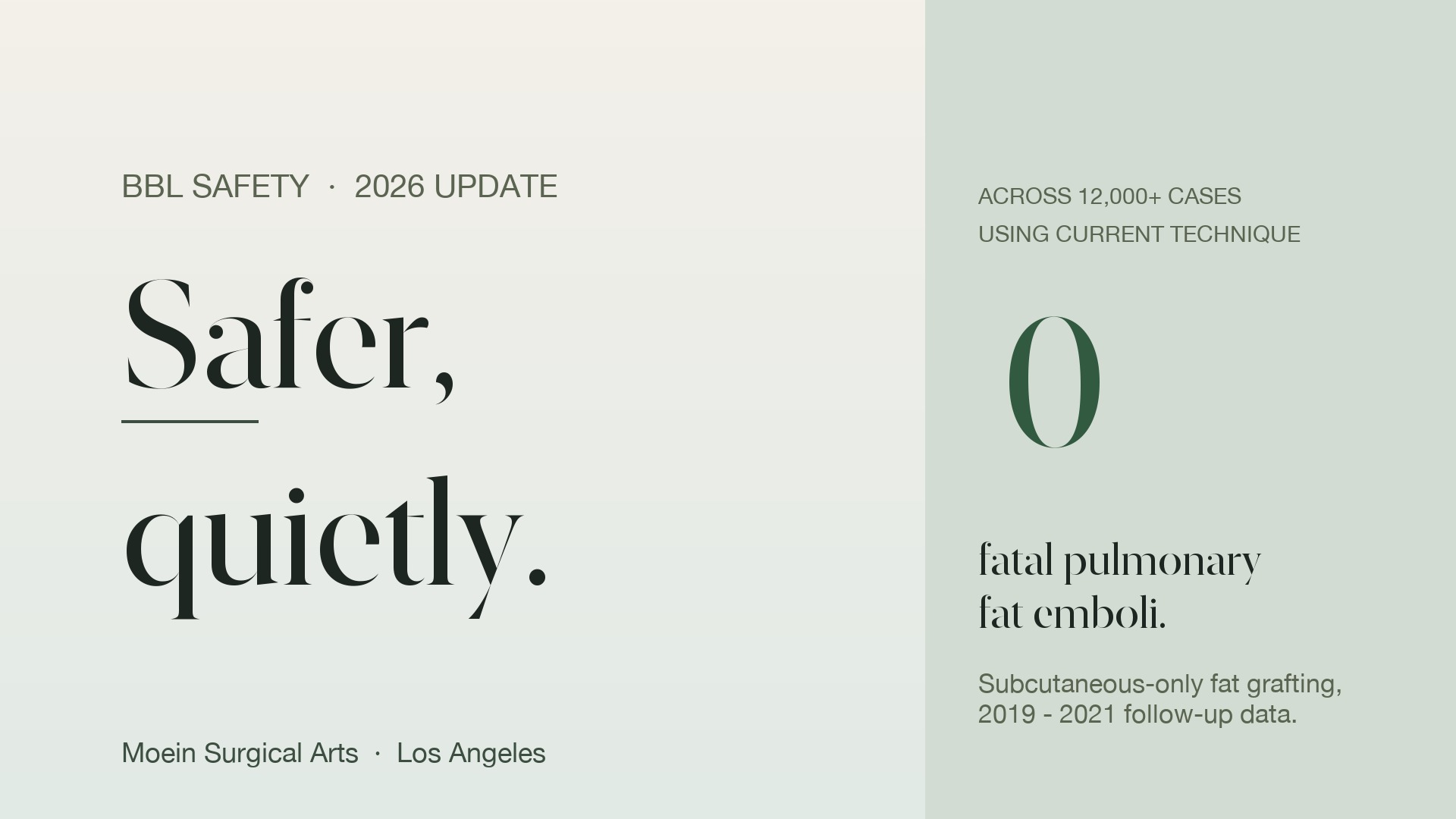
Type “BBL deaths” into Google and you’ll get a wall of articles built around the same statistic: a 1-in-3,000 mortality rate. That number is real. It came out of a South Florida mortality review in 2017 that genuinely shook the field and pushed the American Society of Cosmetic Surgeons into an emergency warning. It’s also the single most-cited fact about the procedure, and it’s almost a decade old.
The conversation about BBL safety in 2026 doesn’t look much like the one Google still surfaces. Patients walk into consultations with the 2017 number in their head and they deserve an honest answer about what changed since then. Here it is, including the parts that aren’t flattering.
Where the 1-in-3,000 number actually came from
The 2017 warning was driven by a multi-year mortality review concentrated in South Florida. Researchers documented a fatality rate near 1-in-3,000, and the cause was usually the same: fat injected too deep, into or below the gluteal muscle, where it could enter blood vessels and travel to the lungs as a pulmonary fat embolism.
That warning changed two things. It changed how the procedure is taught. And it tightened, eventually, who actually performs it well, because a meaningful share of the BBLs being done in 2017 were not being done by board-certified surgeons in accredited surgical facilities.
What the credential actually is
Two surgical boards in the United States carry the rigor required for BBL: the American Board of Plastic Surgery (ABPS) and the American Board of Cosmetic Surgery (ABCS). They credential through different paths but with comparable rigor.
ABPS-certified surgeons complete a plastic surgery residency. ABCS-certified surgeons complete a residency in a related surgical field (general surgery, OB-GYN, head-and-neck, dermatology, or plastic surgery itself), then complete a one-year accredited cosmetic surgery fellowship dedicated to high-volume aesthetic training. Both boards require written and oral examinations, accredited facility privileges, and ongoing maintenance of certification.
For BBL specifically, what matters is that the surgeon holds certification from one of these two boards and uses current technique in an accredited operating room. A surgeon “board-certified” in something unrelated, or in no board at all, is not in the same category and the safety data reflects that.
What changed in the operating room
Two technical shifts did most of the work. The first was a strict move to subcutaneous-only fat grafting: the fat goes above the muscle, never into it or below it. The second was the routine use of intraoperative ultrasound, which lets a surgeon see the cannula tip in real time relative to the muscle fascia.
Subcutaneous-only injection alone reduced fatal embolism dramatically. Ultrasound closed most of what remained, because once you can see exactly where the cannula is, drifting into deep tissue stops being an accident waiting to happen.
The newer data the headlines haven’t caught
Follow-up surveys of board-certified surgeons using the post-warning technique tell a story that hasn’t really hit the public conversation. Across more than 12,000 documented cases between 2019 and 2021 using subcutaneous-only fat grafting, zero fatal pulmonary fat emboli were reported. Centers running ultrasound-guided BBL programs have published similar zero-fatality outcomes, with safety profiles that line up with other major body procedures.
That doesn’t make BBL risk-free. Every surgery has risk. But the distance between “deadliest cosmetic surgery” and “comparable to other major cosmetic surgeries” is the real story of the last five years. Most patients I see have never heard it.
So why does the old number still dominate?
Because the risk hasn’t disappeared. It moved.
The deaths still happening in 2026 cluster in two places: medical tourism destinations with weak regulatory oversight, and practitioners without ABPS or ABCS certification performing the procedure outside accredited facilities. A patient flying to a discount BBL clinic abroad is taking on a different risk than a patient walking into an AAAHC-accredited operating room in Los Angeles.
The public health data tracks this. Mortality patterns follow the regulatory environment more closely than they follow the procedure name. The same operation, in the same year, performed two different ways, has two different safety profiles.
The question patients keep asking
Some version of “would you let your wife or your sister have this done?” comes up in almost every BBL consultation now. People ask it because they’ve read the Newsweek piece where surgeons were quoted anonymously saying they wouldn’t personally get one.
The answer in 2026, with a board-certified surgeon (ABPS or ABCS), ultrasound-guided subcutaneous-only technique, and an accredited facility, is yes. The answer changes the moment any one of those three is missing.
The aesthetic moment is shifting too
This part has nothing to do with mortality, but it matters. The hyper-projected, maximum-volume BBL of 2018 to 2022 is no longer what most patients are asking for. A real and growing group of women is now coming in for reversal or reduction on results that felt right four years ago and feel exaggerated now.
That changes how I plan a primary BBL today. Patients are asking for natural proportions and an outcome that ages well. The conservative conversation is back on the table in a way it wasn’t in 2019, and that’s a good thing for both safety and longevity of result.
How to evaluate a BBL surgeon in 2026
If you’re researching the procedure, here are the six questions whose answers actually tell you something:
1. Are you board-certified by the American Board of Plastic Surgery (ABPS) or the American Board of Cosmetic Surgery (ABCS)? Either is acceptable. Both require accredited training, examinations, and ongoing maintenance. What you want to avoid is “board-certified” with no board named, or certification in an unrelated specialty being implied as cosmetic-surgery credentialing.
2. Is the surgical facility AAAHC, AAAHC, or state-licensed? An accredited operating room is a hard line, not a preference.
3. Do you use intraoperative ultrasound during fat grafting? If the answer is no, find another surgeon. This is the standard of care now.
4. Is your fat grafting strictly subcutaneous? The answer you want is some version of “yes, exclusively above the muscle.”
5. What is your annual BBL volume and your complication rate? A surgeon who knows these numbers and tells you them is a surgeon who tracks them seriously.
6. What does revision look like in your practice? Even with perfect technique, results evolve. The plan for that matters.
If a surgeon hesitates on any of these, take that as information.
Frequently asked questions
Is the 1-in-3,000 mortality figure still accurate?
Not for board-certified surgeons (ABPS or ABCS) using current subcutaneous-only technique with intraoperative ultrasound. The historical figure was driven by cases that included deep intramuscular injections, often performed outside accredited facilities and outside legitimate board credentialing. The current safety profile in compliant US practices is dramatically better.
Is there a meaningful difference between an ABPS Cosmetic Surgeon and an ABCS cosmetic surgeon for BBL?
Not for the patient’s safety calculus, no. Both boards require completed surgical residency, specialty training, written and oral examinations, accredited facility privileges, and maintenance of certification. The training paths are different but the rigor is comparable. What matters far more than which of the two boards is which technique the surgeon uses, what facility they operate in, and how many BBLs they perform per year.
What’s the actual mortality number now?
Across more than 12,000 documented cases between 2019 and 2021 using current technique, zero fatal pulmonary fat emboli were reported. The risk hasn’t gone to zero (no surgery does), but fatal complications in compliant US practices are now rare events rather than ones the field expects to see annually.
Is medical tourism really more dangerous?
Yes. Mortality data tracks closely with regulatory environment. Cost-driven travel to facilities with weaker oversight, less surgical accreditation, and surgeons who may not hold ABPS or ABCS certification is where most of the remaining BBL risk concentrates.
Why do some surgeons say they wouldn’t get one themselves?
That Newsweek piece was published before the technique evolution had fully spread through the field. Many of those surgeons would give a different answer in 2026 if asked specifically about ultrasound-guided subcutaneous-only BBL by a board-certified colleague using current standards.
What about the BBL reversal trend I keep seeing online?
It’s real and it’s growing, but it’s primarily aesthetic, not safety-related. Patients who got large-volume results in 2018 to 2022 are finding the outcome no longer matches the look they want or the way their body has changed. Reduction and revision options are part of what most LA practices now offer.
How does the cost compare to other procedures?
BBL costs in Los Angeles run in a similar range to other major body procedures, with the variables being surgical volume, anesthesia time, and combination cases. The butt lift cost breakdown walks through what drives the number.
The honest takeaway
BBL went through a hard public reckoning between 2017 and 2021. The technique evolved, the credentialing tightened (across both ABPS and ABCS), and the data on compliant US practices shifted substantially. That story hasn’t fully reached the public conversation, where the 2017 figure still leads every search result.
If you’re considering a BBL today and trying to figure out whether it’s safe enough for you, the answer depends almost entirely on who is doing it and where. Same surgery, two ways of performing it, two different risk profiles. A patient making this decision deserves to know which one they’re actually choosing.
If you’d like to ask any of these questions in person, I do virtual consultations from Los Angeles. The pre-surgical conversation is where the safety of any procedure is really established.
Dr. Babak Moein is a board-certified surgeon in Los Angeles, certified by the American Board of General Surgery and a Diplomate of the American Board of Cosmetic Surgery. His practice focuses on body contouring, mommy makeover, and breast procedures. More on Dr. Moein’s training and approach.
]]>
Patients ask me a lot of questions during a mommy makeover consultation. Almost none of them are about the surgery. They want to know about the recovery, in real terms. What week 1 actually feels like. When they can pick their toddler up. When they’ll stop feeling like a stranger in their own body.
The reason that question dominates the room is that the recovery is the part most people feel they got the least honest information about. Spend an hour reading through r/tummytucksurgery or the mommy makeover threads on r/PlasticSurgery and you’ll see the same complaint over and over: “my surgeon glossed over week one.”
So here it is, week by week, with the unflattering parts left in.
The pre-op window matters more than people realize
Recovery doesn’t start on surgery day. It starts about eight weeks earlier. The two things that change outcomes the most before you ever get on the table are stable weight and zero nicotine. By zero nicotine I mean cigarettes, vapes, gum, lozenges, patches, all of it.
The reason is mechanical, not moralistic. Nicotine constricts the small blood vessels that feed your skin during healing. After a tummy tuck, those vessels are doing the work of keeping a long incision alive while the tissue underneath knits together. A patient I saw recently quit vaping the day before her scheduled surgery date. We rescheduled her. Wound complications in a smoker aren’t a bad week, they’re a bad year.
If you’re on Wegovy, Ozempic, or another GLP-1, bring that up early. Hold protocols vary, and post-weight-loss anatomy creates a different surgical plan than the standard mommy makeover. Many of these patients end up with a more customized procedure combination built around the skin laxity that comes with rapid weight loss.
Day 0 to Day 3: the foggy stretch
A standard mommy makeover combines a tummy tuck with breast surgery (some combination of lift and augmentation) and usually some liposuction of the flanks. Surgery time runs four to six hours under general.
You wake up in a compression garment, with one or two drains taped to your side. The drains are the part nobody describes well in advance. They’re not painful, they’re just present, and they get pulled out at the end of week one. Until then they’re a nuisance you carry around in a small fabric pouch.
You won’t stand up straight for the first week. The tummy tuck closure is under tension, and walking slightly bent forward is what protects it. You’ll sleep on a recliner or with the bed angled at 45 degrees. Pain peaks in the first 48 hours and is managed with prescription medication plus a long-acting local anesthetic placed during surgery. Most patients describe this stretch as deep soreness rather than sharp pain.
Day 3 to Day 5: the worst emotional window
This is the part the brochures skip. Every patient forum I’ve ever read describes the same thing: somewhere between day 3 and day 5, women hit a wall. The anesthesia is gone, the swelling is at its peak, and they’ve seen themselves in a full-length mirror. They’re tired, they’re sore, and they’re starting to think they made a mistake.
It’s a real phenomenon, and there’s a reasonable physiologic explanation. Your nervous system is processing a significant surgical event while your body is at maximum inflammation. Cortisol is elevated. You’re sleeping in a chair. Of course you feel awful.
By day 7, almost every patient I’ve followed reports turning a corner. But you have to know day 4 is coming, or it ambushes you. Tell your spouse, your sister, your mother, whoever is helping you. They need to be ready for it too.
Week 1: drains, garment, no toddlers
Drains usually come out at the end of week one. The removal is uncomfortable for about ten seconds and undramatic for the rest of it. The compression garment stays on 23 hours a day. It comes off only for a shower and a quick wash.
The hard rule for week one is nothing heavier than a gallon of milk. That includes children. If you have a one-year-old or a two-year-old, this is the part patients consistently underestimate. You can’t pick them up out of the crib. You can’t carry them upstairs. You probably shouldn’t be the one giving them a bath. Plan childcare for at least the first two weeks. Couples who don’t plan this hit week one resentful and exhausted.
Week 2: the corner turn
By the end of week two, most patients are off prescription pain medication, showering normally, and walking around the block. A surprising number of women return to a desk job around day 10 to 14, especially if they can work from home with flexible hours.
The compression garment stays on. Swelling is still significant, and the abdomen looks fuller than the eventual result for several months. This is the phase where patients start second-guessing the surgery, looking at themselves at week 2 and worrying that what they’re seeing is the final shape. It isn’t.
Weeks 3 and 4: back to office life
Most women return to office work between week three and week four. Driving, light cooking, and short shopping trips are back. Lifting is still off the table. The garment is still on.
Around week three I start patients on manual lymphatic drainage massage if they haven’t already begun. It’s not a luxury, it’s part of the contouring. One or two sessions a week for the next month or two will visibly reduce swelling and improve the eventual shape. Patients who skip the massage often plateau in their results sooner.
Weeks 5 and 6: light exercise comes back
Around week six you can resume low-impact activity. Walking, gentle yoga without deep core flexion, and a recumbent bike at low resistance are reasonable. Running, weight training, and any real core work waits until week eight at the earliest, and only after I’ve seen you and cleared you in person.
The garment can typically come off during the day around week six. Some patients keep wearing it because it feels supportive, and that’s fine. Your body will tell you when it’s done with the garment.
Months 2 and 3: the contour shows up
This is the phase patients tend to enjoy. The major swelling resolves, your waistline reappears, and the breast position settles into where it’s going to stay. Scars are still pink and slightly raised at this stage, which is normal. Scar care during these months matters more than people think: silicone sheets, sun protection, and consistent moisturization make a measurable difference in how the scars look at the one-year mark.
Months 6 to 12: what you’ll keep
The shape you see at six months is the shape you’ll keep, with small refinements continuing out to twelve months. Scars continue maturing through 18 months post-op, fading from pink to flesh-toned. By the time most patients hit the year mark, they tell me they would do it again. The day-4 patient who was sure she’d made a mistake is the same patient sending me holiday cards in December.
What partners and families need to know
The first 72 hours need actual caregiving, not light support. The day-4 emotional dip will happen and it isn’t personal. The no-lifting rule needs to be enforced even when she insists she’s fine, because the abdominal closure is healing under tension you can’t see from outside. Three things, all of which are easy to underestimate from the outside.
Frequently asked questions
How long do I really need off work?
Two weeks if you have a desk job and flexible hours. Three to four weeks if your work involves lifting, long stretches of standing, or any childcare. Surgeons who say “back at it in a week” aren’t lying, they’re quoting the absolute minimum. That isn’t what most patients actually do.
When can I lift my kids?
Two weeks before you can squat down to their level for a hug. Six weeks before you should be picking them up and carrying them. This is the most asked question in my consult room, and the answer is firm.
How long until I can wear regular clothes?
Loose clothing from day one. Jeans usually fit again by week three or four. Anything fitted at the waist will feel tight until month two or three because of swelling.
Will the numbness be permanent?
Some numbness across the lower abdomen is common for the first three to six months and almost always resolves. A small patch of altered sensation low on the abdomen is normal long-term and rarely something patients notice in daily life.
When do I see the final result?
Six months for the contour, twelve months for the scars to mature into their long-term color, eighteen months for the most refined scar appearance. Before and after photos from real patients give the clearest picture.
What does it cost in Los Angeles?
It depends on which procedures you combine. The current mommy makeover cost breakdown for Los Angeles walks through it in detail.
The honest takeaway
A mommy makeover is one of the most satisfying procedures we do. The recovery is also one of the more demanding ones in cosmetic surgery, and that mismatch in expectations is what gets patients into trouble. Women who arrive at week one with a realistic week-by-week picture of what’s ahead are almost always glad they did it. Women who expected to feel normal in five days are the ones who get ambushed.
If you’re considering the procedure and want a candid conversation about whether the timeline, your support system, and your pre-op profile line up, schedule a virtual consultation. The questions worth asking are the ones that come up before the surgery, not after.
Dr. Babak Moein is a board-certified surgeon in Los Angeles whose practice focuses on mommy makeover, body contouring, and breast procedures. More on Dr. Moein’s training and approach.
]]>